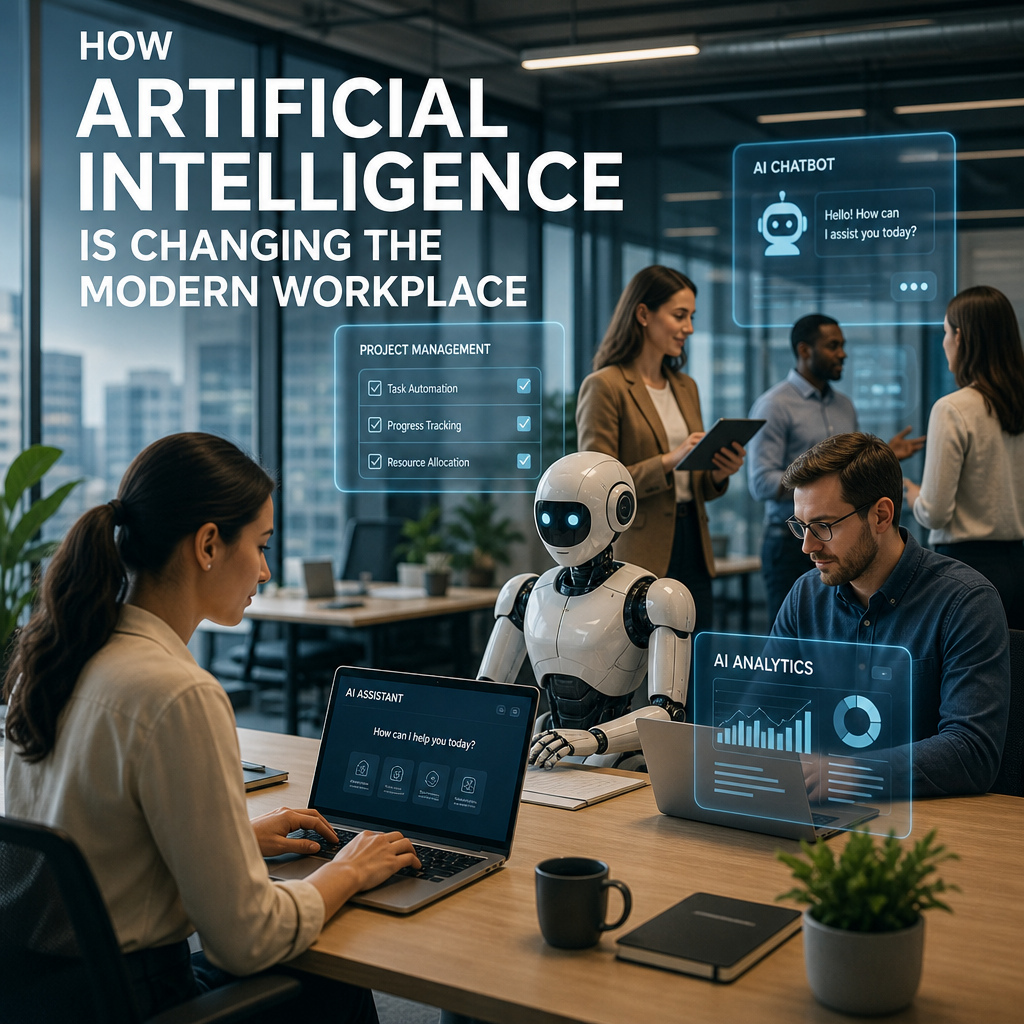
How Artificial Intelligence Is Changing the Modern Workplace
Artificial intelligence in the workplace is transforming how teams handle everything from hiring and scheduling to customer service and data analysis. As AI takes over repetitive tasks, employees can spend more time on creative thinking, problem-solving, and meaningful collaboration.
By: Peter B on julho 30, 2026
Artificial intelligence is no longer a futuristic concept reserved for science fiction or advanced research labs. It is already reshaping how companies hire, communicate, analyze data, serve customers, and make decisions. From small businesses to global enterprises, artificial intelligence in the modern workplace is becoming a practical tool that helps people work faster, smarter, and with fewer repetitive tasks.
But AI is not just about automation. It is changing the way teams collaborate, how managers lead, and what skills workers need to stay competitive. In many industries, AI is helping employees focus on higher-value work while streamlining the tasks that slow them down.
This article explores how artificial intelligence is changing the modern workplace, where it creates the most value, what challenges it brings, and how professionals and organizations can adapt responsibly.
What Artificial Intelligence Means in the Workplace
In simple terms, artificial intelligence refers to computer systems that can perform tasks that usually require human intelligence. In the workplace, that often means software that can:
Analyze large amounts of data
Recognize patterns
Automate routine tasks
Generate text, images, or code
Support decision-making
Improve over time through machine learning
Common AI tools used at work
Many people already use AI at work without realizing it. Examples include:
Email spam filters
Chatbots for customer service
Smart scheduling assistants
Document summarization tools
Predictive analytics platforms
Recruitment software that screens applications
Generative AI tools that draft content or code
These tools are becoming more common because they save time and reduce manual effort. For businesses, that often means better efficiency. For employees, it can mean less repetitive work and more time for creative, strategic, or interpersonal tasks.
How Artificial Intelligence Is Changing the Modern Workplace
Artificial intelligence is changing the modern workplace in several major ways. Some changes are easy to see, while others are happening behind the scenes.
1. Automating repetitive tasks
One of the biggest benefits of AI is automation. Tasks that once required hours of manual work can now be completed in minutes.
Examples include:
Sorting and routing customer support tickets
Processing invoices
Organizing digital files
Transcribing meetings
Updating records
Generating routine reports
This does not mean workers become unnecessary. Instead, AI often takes over the low-complexity work so people can focus on tasks that require judgment, empathy, creativity, and problem-solving.
2. Improving decision-making with data
Modern workplaces generate enormous amounts of data. AI helps companies make sense of that information more quickly.
For example, AI-powered analytics can help teams:
Spot sales trends
Predict staffing needs
Identify operational bottlenecks
Detect fraud or unusual behavior
Forecast customer demand
In practice, this allows managers to make better decisions based on evidence rather than guesswork. A retail team might use AI to anticipate seasonal demand. A hospital might use it to improve scheduling. A finance department might use it to catch errors earlier.
3. Transforming hiring and talent management
Human resources is another area where artificial intelligence in the modern workplace is making a noticeable impact. AI tools can help recruiters and HR teams:
Review resumes
Match applicants to job descriptions
Schedule interviews
Analyze employee engagement
Recommend training programs
This can speed up hiring and reduce administrative work. However, it also creates responsibility. Organizations must make sure AI hiring tools are fair, transparent, and used alongside human judgment. If a system is trained on biased data, it can unintentionally reinforce unfair hiring patterns.
4. Enhancing customer service
Customer service has changed dramatically with AI. Chatbots, virtual assistants, and automated response systems now handle many common questions instantly.
This offers several advantages:
Faster response times
24/7 support availability
Lower wait times for simple issues
Consistent answers to frequently asked questions
Still, AI works best when it supports human agents rather than replaces them entirely. Complex, emotional, or sensitive customer issues often need a real person. The strongest customer service models use AI to handle routine requests and route more difficult cases to trained staff.
5. Supporting remote and hybrid work
AI is also helping remote and hybrid teams stay productive. In distributed workplaces, employees often rely on AI-powered tools to stay organized and connected.
Examples include:
Calendar assistants that schedule meetings across time zones
Collaboration platforms that summarize conversations
Note-taking tools that capture action items
Search tools that help workers find documents quickly
Productivity apps that prioritize tasks
For teams spread across locations, these tools can reduce friction and improve communication. They also help workers spend less time searching for information and more time completing meaningful work.
The Benefits of Artificial Intelligence at Work
When used well, AI can create substantial value for both employers and employees.
Greater efficiency
AI can complete routine tasks quickly and consistently. That frees up time for higher-level work and reduces bottlenecks.
Better accuracy
Machines do not get tired or distracted in the same way humans do. AI can help reduce common errors in data entry, scheduling, forecasting, and document handling.
More informed decisions
With the help of AI, companies can interpret data more effectively and respond faster to changing conditions.
Improved employee experience
When workers spend less time on repetitive tasks, they often have more room for meaningful work. That can improve morale and reduce frustration.
Scalable operations
AI allows organizations to support growth without increasing every function at the same pace. For example, a company can handle more customer inquiries or analyze more data without adding as many manual hours.
Challenges and Risks of AI in the Workplace
Although AI offers real benefits, it is not a perfect solution. Businesses need to understand the risks before adopting it widely.
Job displacement concerns
One of the most common concerns is that AI will replace jobs. In reality, the impact varies by role. Some tasks will be automated, and some jobs will change significantly. Other roles may grow as new needs emerge.
Instead of viewing AI only as a replacement, it helps to see it as a force that reshapes work. Employees who adapt and learn new skills are more likely to remain valuable in changing environments.
Bias and fairness
AI systems learn from data, and data can reflect human bias. If a system is trained on flawed historical patterns, it may make unfair recommendations in hiring, promotions, or evaluations.
That is why companies should:
Review AI outputs regularly
Use diverse training data when possible
Keep humans involved in important decisions
Test for unintended bias
Document how systems are used
Privacy and security
AI tools often rely on large amounts of workplace data. That raises questions about privacy, confidentiality, and cybersecurity. Companies should be careful about what information they share with third-party tools and how they store sensitive data.
Overreliance on automation
AI can be powerful, but it should not replace critical thinking. Workers who trust AI outputs without review may miss errors, inaccuracies, or incomplete context.
A smart workplace uses AI as a support tool, not an unquestioned authority.
Skills Workers Need in an AI-Driven Workplace
As AI becomes more common, the most valuable workers will be those who can use it wisely. That means developing a mix of technical and human skills.
Key skills for the future of work
Critical thinking: evaluating AI outputs and spotting problems
Digital literacy: understanding how modern tools work
Communication: explaining ideas clearly to teams and clients
Adaptability: learning new systems as they evolve
Creativity: generating original ideas AI cannot fully replicate
Emotional intelligence: handling people-centered work with empathy
Data awareness: knowing how to interpret information responsibly
Practical ways to build these skills
Workers can prepare by:
Learning how their company’s AI tools function
Practicing prompt writing for generative AI platforms
Reviewing AI-generated content carefully before using it
Taking courses in data analysis, automation, or digital tools
Asking managers how AI is being used in their organization
The goal is not to become an AI expert overnight. It is to become a confident, informed user who can work effectively alongside intelligent systems.
How Businesses Can Adopt AI Responsibly
Organizations that want to benefit from AI should do more than buy new software. They need a thoughtful strategy.
Start with clear use cases
AI works best when it solves a specific problem. Instead of adopting it everywhere at once, businesses should identify areas where it can save time, improve accuracy, or support better decisions.
Good starting points might include:
Customer support automation
Internal document search
Sales forecasting
Meeting transcription
Workflow routing
Involve employees early
Workers are more likely to trust AI when they understand how it helps them. Leaders should explain the purpose of new tools, invite feedback, and show how AI supports—not replaces—human work.
Set rules for responsible use
Companies should create policies around:
Data privacy
Human review requirements
Approved use cases
Bias testing
Security standards
These guardrails help prevent misuse and make AI adoption more sustainable.
Invest in training
AI tools are only useful if employees know how to use them. Training should include practical examples, not just technical definitions. Workers need to understand both the capabilities and limitations of each tool.
Real-World Examples of AI in the Modern Workplace
Here are a few examples of how artificial intelligence is changing the modern workplace across industries:
Marketing teams
Marketers use AI to:
Draft content outlines
Analyze campaign performance
Personalize customer messages
Segment audiences
This helps teams move faster while making more informed decisions.
Healthcare organizations
In healthcare, AI can assist with administrative tasks, appointment scheduling, medical imaging analysis, and patient communication. Human oversight remains essential, especially when care decisions are involved.
Manufacturing companies
Manufacturers use AI for predictive maintenance, quality control, and supply chain management. These tools can help reduce downtime and improve production planning.
Legal and compliance teams
AI can scan documents, identify patterns, and help with research. This saves time, though professionals still need to verify accuracy and apply legal judgment.
Education and training departments
Organizations use AI to create personalized learning recommendations, summarize materials, and support employee development programs.
The Future of Artificial Intelligence in the Workplace
The role of AI in work will likely continue to expand, but the most successful organizations will be those that balance innovation with human judgment.
We are likely to see:
More AI-assisted workflows
Better integration across business tools
Greater personalization in training and development
Stronger demand for digital and analytical skills
Ongoing conversations about ethics, governance, and transparency
AI will not eliminate the need for people. Instead, it will change what people do and how they do it. The most resilient teams will be those that learn to use AI as a partner in performance, not a substitute for expertise.
Frequently Asked Questions
1. How is artificial intelligence changing the modern workplace?
Artificial intelligence is changing the modern workplace by automating repetitive tasks, improving data analysis, supporting hiring, enhancing customer service, and helping teams work more efficiently. It allows employees to focus on work that requires creativity, judgment, and human interaction.
2. Will AI replace most jobs?
AI will not replace most jobs entirely, but it will change many roles. Some tasks may be automated, while new responsibilities will emerge. Workers who learn how to use AI and build complementary skills will be better prepared for these changes.
3. What are the biggest benefits of AI at work?
The biggest benefits include improved efficiency, better accuracy, faster decision-making, stronger customer support, and more scalable operations. AI can reduce repetitive work and help businesses respond more effectively to changing demands.
4. What are the main risks of using AI in the workplace?
The main risks include bias, privacy concerns, security issues, and overreliance on automated outputs. Companies should use human oversight, clear policies, and regular reviews to reduce these risks.
5. What skills do employees need to succeed in an AI-driven workplace?
Employees should build critical thinking, digital literacy, adaptability, communication, creativity, and emotional intelligence. It also helps to understand how AI tools work and how to evaluate their results responsibly.
Artificial intelligence is changing the modern workplace in ways that are practical, visible, and increasingly essential. It is helping organizations automate repetitive tasks, improve decision-making, strengthen customer service, and support remote collaboration. At the same time, it is raising important questions about fairness, privacy, bias, and the future of work.
The companies and professionals who benefit most from AI will be the ones who use it thoughtfully. That means choosing the right tools, keeping humans involved in important decisions, and investing in ongoing training. It also means recognizing that AI works best when it complements human strengths rather than trying to replace them.
Whether you are an employee adapting to new tools or a leader planning your organization’s next step, the most important move is to stay informed and proactive. The workplace is changing, and AI is a major part of that shift. Learning how to use it well can help you stay competitive, improve productivity, and build a more resilient future.
Peter B holds a degree in Journalism and has 5 years of experience covering U.S. economic policy, labor markets, and financial news. He writes data-driven news content on topics like inflation, interest rates, and employment trends.