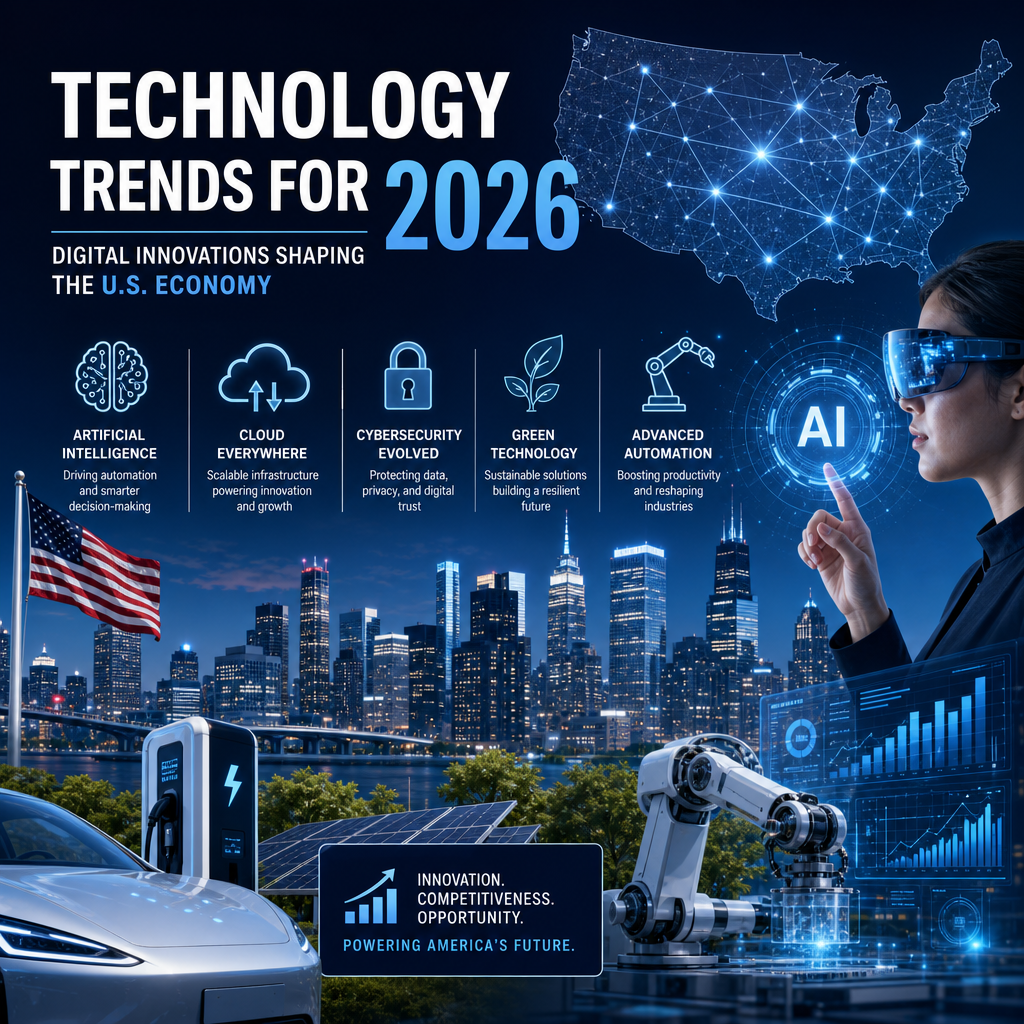
Technology Trends for 2026: Digital Innovations Shaping the U.S. Economy
Technology trends for 2026 are moving from hype to real-world impact, helping U.S. businesses work smarter, reduce risk, and stay competitive. From AI-driven automation to stronger digital infrastructure, these changes are already shaping the economy in meaningful ways.
By: Peter B on julho 30, 2026
Technology trends for 2026 are already reshaping how American businesses operate, compete, and grow. From AI-powered workflows to smarter manufacturing systems and more secure digital infrastructure, these innovations are not just changing individual industries—they are influencing the broader U.S. economy in measurable ways. Companies that understand where digital transformation is headed can make better decisions, reduce risk, and stay competitive in a fast-moving market.
In this article, we’ll explore the most important technology trends for 2026, why they matter to the U.S. economy, and how organizations can prepare for what comes next.
Why Technology Trends for 2026 Matter to the U.S. Economy
The U.S. economy depends on productivity, innovation, and adaptability. New technologies affect all three. They help companies automate routine work, improve customer experiences, strengthen supply chains, and create new products and services.
For business leaders, policymakers, and workers, understanding technology trends for 2026 is essential because these changes influence:
Job roles and required skills
Business investment priorities
Operational efficiency
Cybersecurity risk
Consumer expectations
Industry competitiveness
The companies that respond early tend to capture more value. The ones that wait often face higher costs and slower growth.
1. Artificial Intelligence Moves From Experimentation to Execution
Artificial intelligence will remain one of the most important technology trends for 2026, but the focus is shifting. Instead of asking whether AI works, companies are asking how to use it responsibly and profitably at scale.
What’s changing
Businesses are moving beyond isolated AI pilots and adopting AI in real workflows. Common uses include:
Customer service automation
Fraud detection
Sales forecasting
Document processing
Personalized marketing
Software development support
Generative AI is also becoming more practical. Teams are using it to draft reports, summarize data, and accelerate content creation. In many organizations, AI will function as a digital assistant rather than a standalone replacement for human judgment.
Economic impact
AI can boost productivity by helping employees complete tasks faster and with fewer errors. That matters for the U.S. economy because productivity growth supports long-term expansion, higher output, and stronger business margins.
But AI also raises important questions:
How should companies verify AI-generated outputs?
Which tasks should stay human-led?
How do organizations protect sensitive data used in AI systems?
The winners in 2026 will likely be the companies that combine AI tools with clear oversight, training, and governance.
2. Automation Expands Across White-Collar and Industrial Workflows
Automation is no longer limited to factories or repetitive back-office tasks. In 2026, it will continue expanding into office environments, logistics, healthcare administration, finance, and retail operations.
Where automation is growing
Automation tools are being used for:
Invoice processing
Appointment scheduling
Inventory management
Compliance workflows
HR onboarding
Supply chain tracking
In the industrial sector, robotics and machine vision continue to improve precision and reduce downtime. In office settings, workflow automation reduces manual data entry and helps teams focus on higher-value work.
What this means for businesses
Automation can increase efficiency, but it works best when paired with strong process design. Companies should not automate broken workflows. Instead, they should first map tasks, identify bottlenecks, and then apply automation where it creates real value.
For workers, this trend reinforces the importance of digital literacy, problem-solving, and adaptability. Routine tasks may shrink, but new roles often emerge around oversight, analysis, and exception handling.
3. Cybersecurity Becomes a Core Business Strategy
As digital systems become more interconnected, cybersecurity is becoming one of the most critical technology trends for 2026. Threats are growing more sophisticated, and the cost of a breach can affect operations, reputation, and customer trust.
Key cybersecurity shifts
Organizations are focusing more on:
Zero trust security frameworks
Multi-factor authentication
Identity and access management
Endpoint protection
Cloud security
Employee security training
Ransomware, phishing, and supply chain attacks remain major concerns. At the same time, AI is being used by both defenders and attackers. That makes security posture even more important.
Why it matters economically
Cyber incidents can disrupt entire business ecosystems. A security failure at one vendor can affect customers, suppliers, and partners across multiple industries. In 2026, companies that treat cybersecurity as a board-level priority will be better positioned to avoid costly disruptions.
Practical steps include:
Regularly update systems and software
Limit user access based on need
Back up critical data securely
Train employees to spot social engineering attempts
Test incident response plans
4. Cloud Computing Gets Smarter and More Specialized
Cloud computing has already transformed how U.S. businesses store and manage data. In 2026, the trend is moving toward more specialized and hybrid cloud environments. Companies want flexibility, lower costs, and better control over sensitive information.
What’s evolving in the cloud
Many organizations are adopting:
Hybrid cloud models
Industry-specific cloud platforms
Edge computing for faster local processing
Cloud cost optimization tools
Better data governance systems
The result is a more tailored approach. Rather than moving everything to one cloud environment, businesses are selecting the right setup for each workload.
Business value
Smarter cloud strategies can reduce infrastructure costs, improve scalability, and support innovation. They also help companies respond faster to changing demand, which is especially important in sectors like retail, healthcare, logistics, and financial services.
Cloud maturity is increasingly tied to competitiveness. Firms that manage cloud environments effectively can scale more quickly and adapt to market changes with less friction.
5. Edge Computing Supports Faster Decision-Making
Edge computing is gaining momentum as more devices generate data in real time. Instead of sending everything to a central cloud or data center, edge systems process information closer to where it is created.
Real-world use cases
Edge computing is particularly useful in:
Smart factories
Connected vehicles
Healthcare monitoring
Retail analytics
Energy systems
Warehouse operations
For example, a manufacturing sensor can detect irregular equipment behavior and trigger an immediate response without waiting for a distant server to process the data.
Why it matters in 2026
Speed matters. In sectors where every second counts, edge computing supports faster decisions and reduces latency. It also helps conserve bandwidth and improve resilience.
As businesses deploy more sensors, cameras, and connected devices, edge infrastructure will become a key part of digital operations.
6. Digital Payments and Fintech Continue to Reshape Commerce
Fintech remains a major force among technology trends for 2026. Consumers and businesses increasingly expect fast, secure, and convenient payment options.
Areas of innovation
Growth continues in:
Real-time payments
Embedded finance
Mobile wallets
Digital banking tools
Fraud prevention systems
Small-business lending platforms
These tools are changing how money moves through the economy. They make transactions easier for consumers, but they also help businesses improve cash flow and reduce payment friction.
Economic implications
Digital payments support faster commerce and more efficient financial operations. Small businesses, in particular, benefit from tools that simplify invoicing, payment collection, and access to capital.
As fintech expands, trust and compliance remain essential. Clear consumer protection practices and strong identity verification will help maintain confidence in digital financial systems.
7. Data Analytics Becomes More Predictive and Actionable
Data has long been a business asset, but the next phase is about turning data into faster, more useful decisions. In 2026, analytics tools are becoming more predictive, automated, and accessible to nontechnical teams.
What companies are doing differently
Businesses are using analytics for:
Demand forecasting
Customer behavior insights
Operational planning
Risk assessment
Performance tracking
Personalized recommendations
Instead of waiting for monthly reports, leaders want near real-time insights that support immediate action.
The advantage
Predictive analytics helps organizations move from reactive to proactive management. A retailer can better plan inventory, a hospital can optimize staffing, and a manufacturer can anticipate maintenance needs before equipment fails.
To get real value, companies need clean data, consistent definitions, and strong internal governance. Data quality remains just as important as analytics software.
8. Sustainability Tech Gains Economic Importance
Sustainability is no longer only a branding issue. It is becoming a practical business concern tied to energy costs, regulatory pressure, and long-term resilience. Technology trends for 2026 include more tools that help organizations use resources efficiently and reduce waste.
Examples of sustainability tech
Companies are investing in:
Energy management software
Smart building systems
Carbon tracking tools
Electric fleet management
Resource optimization platforms
Circular supply chain technologies
Why this matters to the economy
More efficient energy use and smarter resource planning can lower operating costs. For some industries, sustainability tech also helps meet customer expectations and compliance requirements.
Businesses that align innovation with resource efficiency may be better prepared for a future where cost control and environmental responsibility go hand in hand.
9. Workforce Technology and Skills Development Accelerate
One of the most important technology trends for 2026 is not a device or platform—it’s the changing workplace. As digital tools spread, companies need employees who can use them effectively.
What employers are prioritizing
Organizations are investing in:
Digital training
AI literacy
Remote collaboration tools
Knowledge management systems
Internal learning platforms
Performance support tools
Workers are expected to collaborate with technology, not just use it passively. That means understanding how to interpret data, evaluate outputs, and apply judgment.
The business case
Companies with stronger training systems can adopt technology faster and more successfully. They also improve retention by helping employees grow into new roles.
For the U.S. economy, workforce development is a major factor in whether digital transformation leads to broad productivity gains or uneven gains across industries.
How Businesses Can Prepare for Technology Trends for 2026
Adopting every new tool is not the goal. The real challenge is choosing the right technologies and integrating them in a way that supports business strategy.
A practical preparation checklist
Businesses can start with these steps:
Assess current capabilities
Identify where systems are outdated, fragmented, or too manual.
Prioritize business outcomes
Focus on technologies that improve revenue, efficiency, resilience, or customer experience.
Strengthen cybersecurity
Build security into every digital initiative from the start.
Invest in training
Help employees understand and use new tools confidently.
Improve data governance
Clean, secure, and well-managed data supports better decisions.
Test before scaling
Launch pilot projects, measure results, and refine before rolling out broadly.
Track regulatory changes
Stay aware of rules affecting AI, privacy, payments, and digital operations.
This approach reduces risk and increases the chances that technology delivers real value.
Common Challenges to Watch
Even promising innovation can create problems if it is implemented poorly. As businesses adopt new digital tools, they should watch for:
Overreliance on automation
Weak data quality
Security gaps
Poor user adoption
Vendor lock-in
Unclear return on investment
Technology should support strategy, not replace it. Leaders who ask the right questions early can avoid costly mistakes later.
Frequently Asked Questions
1. What are the most important technology trends for 2026?
The biggest trends include artificial intelligence, automation, cybersecurity, cloud modernization, edge computing, fintech innovation, predictive analytics, sustainability tech, and workforce digitalization. Together, these shifts are changing how U.S. companies operate and compete.
2. How will AI affect the U.S. economy in 2026?
AI is likely to improve productivity by helping businesses complete tasks faster, make better decisions, and reduce repetitive work. It may also reshape job roles and increase demand for digital skills, oversight, and governance.
3. Which industries will feel technology changes the most?
Healthcare, manufacturing, finance, retail, logistics, and professional services are likely to see major changes. These sectors rely heavily on data, workflows, compliance, and customer interaction, making them strong candidates for digital transformation.
4. Why is cybersecurity so important in 2026?
As more business activity moves online, cyberattacks can disrupt operations, expose sensitive data, and damage trust. Strong cybersecurity protects revenue, customer relationships, and long-term business continuity.
5. How can small businesses keep up with technology trends for 2026?
Small businesses should focus on practical tools that solve immediate problems, such as automation for invoicing, cloud-based collaboration, secure payment systems, and basic cybersecurity controls. Training staff and choosing scalable solutions can help them stay competitive without overspending.
Technology trends for 2026 are not just reshaping business tools—they are influencing the direction of the U.S. economy. Artificial intelligence, automation, cybersecurity, cloud modernization, edge computing, fintech, and data analytics are all helping companies move faster, operate smarter, and serve customers more effectively. At the same time, these innovations require better governance, stronger security, and a workforce prepared to adapt.
The most successful organizations will be those that treat technology as a strategic capability rather than a one-time upgrade. That means investing in training, protecting data, improving processes, and choosing tools that solve real business problems. Whether you run a startup, manage a growing company, or lead a large enterprise, now is the time to evaluate your digital readiness and prepare for the opportunities ahead.
By staying informed and acting with purpose, businesses can turn technology change into long-term economic advantage.
Peter B holds a degree in Journalism and has 5 years of experience covering U.S. economic policy, labor markets, and financial news. He writes data-driven news content on topics like inflation, interest rates, and employment trends.