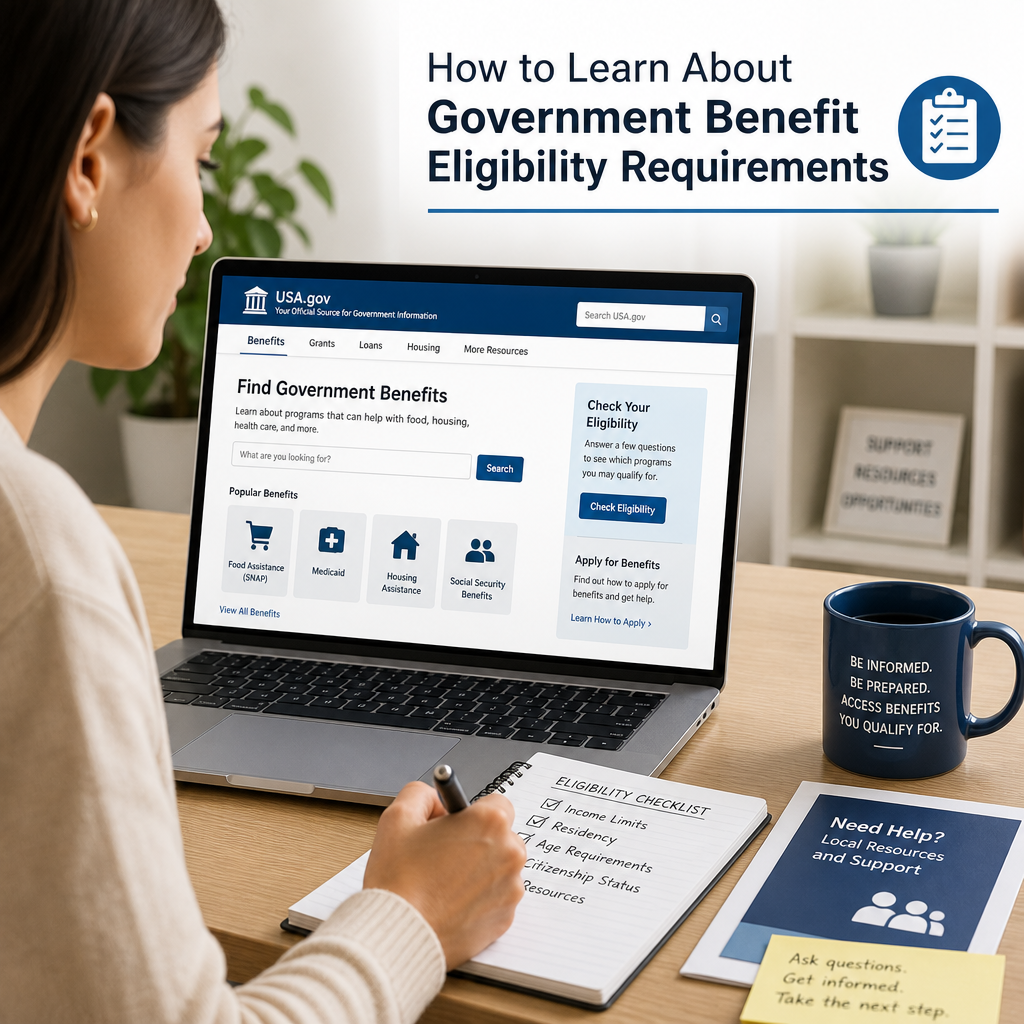
How to Learn About Government Benefit Eligibility Requirements
Learning about government benefit eligibility requirements doesn’t have to be confusing when you start with trusted, official sources and focus on the details that matter most to your situation. A little prep can help you find the right programs, avoid delays, and submit stronger applications with confidence.
By: Emily Adams on julho 31, 2026
Understanding government benefit eligibility requirements can feel overwhelming at first, especially when you’re trying to figure out which programs you may qualify for and what documents you need. Whether you’re looking into food assistance, health coverage, housing support, unemployment benefits, or financial aid, the rules can vary widely by program, state, and household situation.
The good news is that you can learn the basics without getting lost in confusing jargon. With the right approach, you can identify reliable sources, compare program rules, and avoid common mistakes that delay or derail applications. This guide breaks down how to learn about government benefit eligibility requirements in a clear, practical way so you can move forward with confidence.
Why Government Benefit Eligibility Requirements Matter
Before you apply for any public assistance program, it helps to understand the eligibility rules. These requirements determine whether you qualify based on factors like:
Income
Household size
Age
Disability status
Employment status
Immigration or citizenship status
Where you live
Current assets or resources
Some programs use strict thresholds, while others weigh multiple factors together. For example, one benefit might focus mainly on household income, while another may also require residency in a certain state or enrollment in a specific school district.
Learning the rules ahead of time can help you:
Save time by applying only for programs that fit your situation
Gather the correct documents before submitting an application
Avoid delays caused by incomplete or inaccurate information
Understand your rights if your application is denied
Find other benefits you may not have considered
Start With the Official Program Source
The most reliable way to learn about government benefit eligibility requirements is to go directly to the official agency that runs the program. This is especially important because social media posts, third-party blogs, and outdated articles often oversimplify or misstate the rules.
What to look for on official websites
Most government benefit websites include a section labeled one of the following:
Eligibility
Who can apply
Am I eligible?
Program requirements
How to qualify
These pages usually explain the basic rules in plain language and may also provide a screening tool or benefits calculator.
Examples of official sources
Depending on the benefit, you may need to check:
Federal agency websites
State human services departments
County or city social service offices
School district websites for education-related aid
Health insurance marketplaces or Medicaid sites
When in doubt, look for a website ending in .gov or a clearly identified official agency page.
Identify the Type of Benefit You’re Researching
Eligibility rules are easier to understand when you narrow your search to one specific program at a time. “Government benefits” is a broad category, and each program has its own standards.
Common benefit categories
Here are a few examples:
Food assistance
Programs like SNAP may consider income, household size, and expenses.
Health coverage
Medicaid and related programs often use income, family size, age, disability, and state-specific rules.
Cash assistance
Temporary assistance programs may have work requirements, time limits, and income restrictions.
Housing support
Eligibility may depend on income, family composition, local availability, and background checks.
Unemployment benefits
These usually require recent work history, a qualifying job separation, and active job searching.
Student aid
Federal aid often depends on household income, dependency status, enrollment status, and academic progress.
Once you know the exact program, you can focus on the right requirements instead of trying to interpret broad generalizations.
Learn the Core Eligibility Factors
While each program is different, many benefit applications ask about a similar set of information. Understanding these common factors makes it easier to evaluate whether you may qualify.
Income
Income limits are one of the most common eligibility rules. The program may count:
Wages
Self-employment income
Unemployment payments
Retirement income
Child support
Other public benefits
Be careful: some programs count gross income, while others use net income after certain deductions. That distinction can make a significant difference.
Household size
Many benefits adjust based on how many people live with you or share your finances. In some cases, household size includes dependents, spouses, or unrelated adults who purchase and prepare food together.
Residency
You may need to live in a specific state, county, or school district. Some benefits also require proof that you intend to stay there.
Age and family status
Programs for children, seniors, pregnant people, or caregivers often have special rules. Age can also affect whether you qualify as a dependent, adult applicant, or head of household.
Disability or medical need
Some benefits require documentation of a disability, chronic illness, or functional limitation. Others offer expanded eligibility for people with medical conditions.
Work requirements
Certain programs require recipients to work, search for work, attend training, or participate in approved activities. These rules are often specific and may include exemptions.
Citizenship or immigration status
Eligibility may depend on citizenship, lawful presence, or another qualifying immigration category. Some programs also include mixed-status household rules, which can be confusing without guidance from the official source.
Use Screening Tools and Benefits Checkers Wisely
Many government websites now offer online screening tools that help you estimate whether you qualify for certain benefits. These tools are a smart starting point, but they are not always a final determination.
Benefits of screening tools
They can help you:
Save time by narrowing down your options
See which programs fit your situation
Understand likely eligibility before applying
Prepare documents based on the answers you enter
Limits of screening tools
They may not account for every special rule, local exception, or recent policy change. They also rely on accurate input. If you enter estimated income or household information incorrectly, your results may be misleading.
Best practice
Use the screening tool as a guide, then verify the results on the official program page or by speaking with an agency representative.
Read the Full Eligibility Guidelines, Not Just the Summary
A short summary on a homepage may tell you the basics, but the detailed eligibility page usually contains the important exceptions and documentation requirements.
Pay attention to these details
Monthly versus annual income limits
Whether student income is counted
What counts as household income
Special deductions or exclusions
Rules for seasonal workers, gig workers, or self-employed applicants
Time limits or recertification requirements
Conditions that may disqualify applicants
If the language is hard to follow, look for an FAQ page, application guide, or downloadable handbook from the agency.
Compare Federal, State, and Local Rules
One of the most confusing parts of learning about government benefit eligibility requirements is that the rules may change depending on where you live. A federal program can still be administered differently by state or local offices.
Why location matters
Some programs set broad federal standards but let states decide:
Income thresholds within a range
Application procedures
Verification documents
Additional eligibility categories
Renewal timelines
For example, two people in different states may qualify for the same type of benefit under different rules because the state manages the program differently.
How to handle this
Always check:
The national program page
Your state’s official department site
Local office instructions, if available
That three-step approach helps you avoid relying on outdated or incomplete information.
Gather the Right Documents Early
Once you understand the basic requirements, start collecting the documents you may need. Preparing in advance can reduce delays and make the application process smoother.
Common documents include
Government-issued photo ID
Proof of address
Pay stubs or tax returns
Social Security numbers, if required
Birth certificates for children
Immigration documents, if applicable
Proof of rent, mortgage, or utility costs
Medical documentation, if the program requires it
Job separation paperwork for unemployment claims
Keep digital copies when possible, and make sure the files are clear and readable. If the program accepts uploads, organized documents can speed up processing.
Ask the Right Questions When You Need Help
If you still feel uncertain after reviewing official information, contact the agency directly. That’s better than guessing or relying on secondhand advice.
Questions to ask a representative
What are the income limits for my household size?
Which income sources count toward eligibility?
What documents do I need to verify my application?
Are there exceptions for my situation?
How often do I need to renew or recertify?
What should I do if I disagree with a decision?
When speaking with an agency, take notes on the date, time, and name of the person you spoke with. That record can help if you need to follow up later.
Watch for Common Mistakes
People often miss out on benefits because of avoidable errors. Learning about eligibility is only part of the process; applying carefully matters too.
Common mistakes to avoid
Assuming you don’t qualify without checking the full rules
Using an outdated source
Confusing gross income with net income
Forgetting to include all household members
Missing deadlines
Submitting incomplete documentation
Ignoring renewal notices
Failing to report required changes in income or household status
A careful review before submission can save time and prevent unnecessary denials.
Use Trusted Community Resources
In addition to official government sites, trusted nonprofit organizations, legal aid groups, libraries, and community action agencies can help you understand eligibility requirements. These organizations often explain complicated rules in simpler language and may offer application assistance.
Good places to ask for help
Local public libraries
Community health centers
Legal aid offices
Benefits enrollment organizations
Senior centers
Veteran support organizations
College financial aid offices
Just remember to verify any guidance against the official agency rules, especially if the benefit affects your income, housing, or immigration status.
A Practical Example
Suppose you want to check whether your family may qualify for food assistance and health coverage. A good process would look like this:
Visit the official state or federal website for each program.
Review the eligibility section carefully.
Use the online screening tool, if available.
Gather your household income records and proof of address.
Compare the requirements for both programs.
Call the agency if one part of the rule set is unclear.
Apply only after you understand the documents and deadlines.
This method works because it combines official information, practical screening, and direct confirmation.
How to Stay Updated on Changing Rules
Benefit programs change over time. Income thresholds may shift, forms may be updated, and local offices may adjust procedures. Staying informed helps you avoid problems during renewal or reapplication.
Ways to stay current
Check the official website regularly
Sign up for agency email alerts if available
Save the program’s FAQ page
Revisit eligibility rules before recertifying
Ask the agency if recent policy changes affect your case
This is especially important if your household income changes or you move to a new state.
Frequently Asked Questions
1. Where should I start when learning about government benefit eligibility requirements?
Start with the official agency that administers the benefit. Look for the program’s eligibility page, screening tool, or application guide. These sources are the most accurate and up to date. If the benefit is state-run, check both the federal overview and your state’s official website.
2. How do I know if an online benefits quiz is accurate?
A benefits quiz can be a helpful estimate, but it is not always a final decision. Accuracy depends on the information you enter and whether the tool reflects current rules. Use it as a starting point, then verify the result on the official program page or by calling the agency.
3. What information is usually needed to check eligibility?
Most programs ask for household size, income, address, employment status, age, and sometimes citizenship or immigration information. Some benefits also require proof of disability, rent, medical expenses, or school enrollment. Gathering these details early makes the process easier.
4. Can I qualify for benefits in one state but not another?
Yes. Some programs have national guidelines, but states often have flexibility in how they administer them. That means income limits, documentation rules, and application steps can vary by location. Always review the rules for the state where you live.
5. What should I do if I’m denied benefits but think I qualify?
Read the denial notice carefully and check whether you can appeal. Many programs have a formal appeal or fair hearing process. You can also contact the agency to ask which eligibility factor caused the denial and whether you can submit additional proof or corrected information.
Official Resources
Benefits.gov — Official U.S. government benefits screening tool and program information
Federal Student Aid — Official source for federal student aid eligibility and application guidance
Conclusion
Learning about government benefit eligibility requirements does not have to be confusing. The key is to start with the official program source, focus on one benefit at a time, and pay close attention to the factors that matter most: income, household size, residency, age, work rules, and documentation. Once you understand those basics, you can use screening tools, compare federal and state rules, and prepare your documents before applying.
Taking a careful, organized approach can help you avoid common mistakes and improve your chances of submitting a complete application. It can also save time and reduce stress when you’re already juggling other responsibilities. If you’re unsure about any requirement, contact the agency directly or ask a trusted community resource for help. The more informed you are, the easier it becomes to find the support you may be eligible to receive.
Emily A, holds a Master's degree in Public Administration (MPA) and has over 7 years of experience researching federal and state assistance programs. She writes educational content focused on government benefits, public policy, and community resources, using information from official agencies to help readers understand available programs and eligibility requirements.