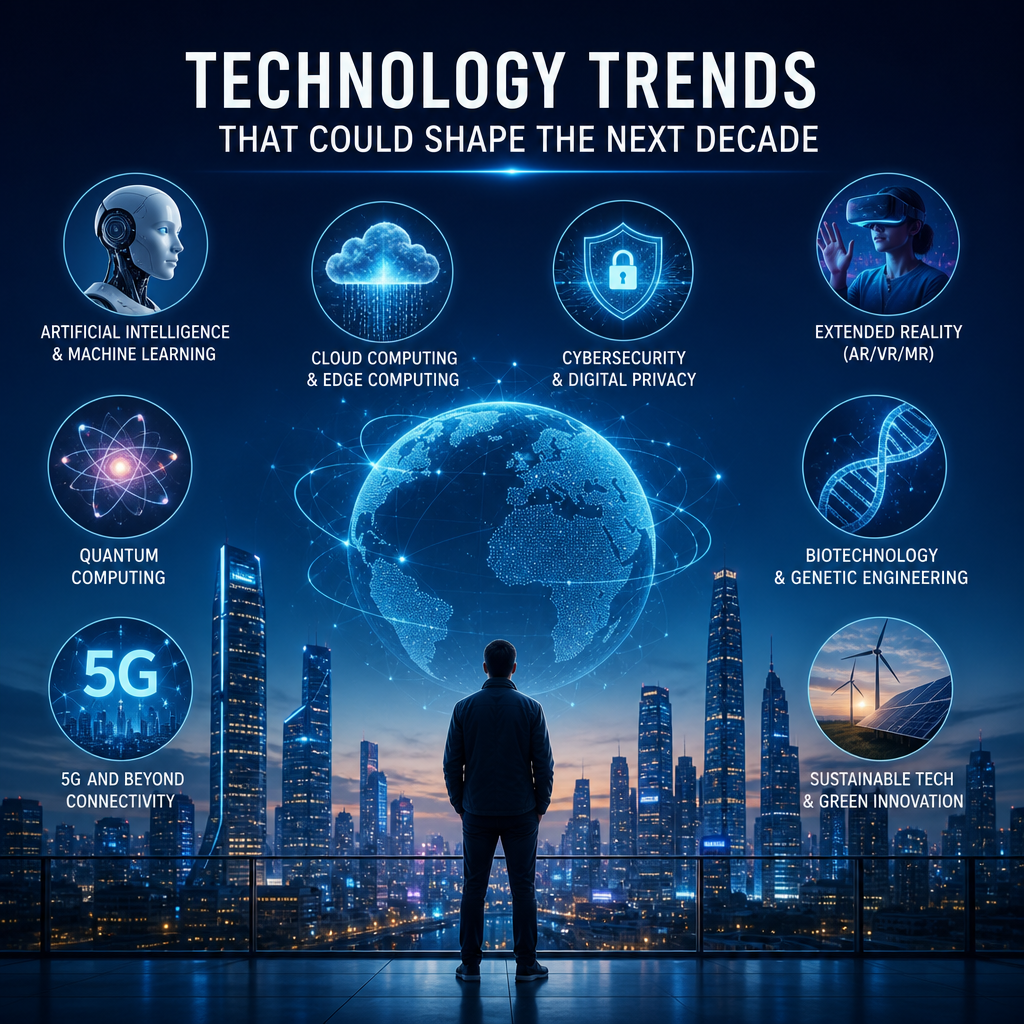
Technology Trends That Could Shape the Next Decade
The next decade will be shaped by technology trends that do more than speed up devices—they’ll change how we work, learn, travel, and make decisions. From AI and automation to clean energy and secure digital infrastructure, these shifts are already setting the stage for a very different future.
By: Peter B on julho 30, 2026
Technology changes fast, but the next ten years may bring a deeper shift than simply faster devices or smarter apps. The most important technology trends will likely reshape how we work, learn, heal, travel, and make decisions. Some of these changes are already visible in everyday tools. Others are still emerging but advancing quickly.
What makes the coming decade especially interesting is the way these trends will overlap. Artificial intelligence, automation, spatial computing, clean energy, and secure digital infrastructure will not evolve in isolation. They will influence one another, creating new possibilities for businesses, governments, and individuals alike.
Below, we’ll look at the technology trends most likely to shape the next decade, why they matter, and how they could affect daily life.
Technology Trends That Could Shape the Next Decade
1. Artificial Intelligence Becomes a Core Utility
Artificial intelligence is no longer a futuristic concept. It already powers search, recommendations, translation, fraud detection, and customer support. Over the next decade, AI will likely move from a helpful feature to a core utility embedded in many products and workflows.
What this means in practice
AI will likely become more useful in three major ways:
Personalized assistance: Tools will anticipate user needs more accurately.
Workflow automation: Businesses will use AI to handle repetitive tasks, summarize information, and support decision-making.
Domain-specific intelligence: AI systems will become better tuned for law, medicine, finance, education, and engineering.
For example, a marketing team might use AI to draft campaign variations, analyze customer feedback, and identify content gaps. A clinician might use AI-powered tools to help review patient records more efficiently, while still making the final medical judgment.
Why it matters
The biggest impact may not come from flashy chatbots. It will come from AI becoming a quiet layer inside everyday software. As these tools improve, users will expect faster responses, more relevant suggestions, and less manual work.
At the same time, organizations will need to focus on accuracy, transparency, and human oversight. AI can accelerate work, but it should not replace careful judgment.
2. Automation Expands Beyond Manufacturing
Automation has long been associated with factories and assembly lines, but that view is too narrow. The next decade will likely see automation spread across office work, logistics, healthcare administration, retail, and even creative workflows.
Areas where automation is growing
Data entry and document processing
Inventory tracking and supply chain coordination
Scheduling and customer communication
Quality checks and compliance tasks
Repetitive content workflows
A small business, for instance, might automate invoice reminders, lead follow-up emails, and appointment scheduling. That doesn’t eliminate the need for employees. Instead, it allows teams to spend more time on work that requires creativity, strategy, and human interaction.
The human side of automation
The most successful organizations will not treat automation as a simple cost-cutting tool. They will use it to improve consistency and free up people for higher-value tasks. That requires training, process redesign, and clear communication.
Workers will also need opportunities to build new skills. As automation grows, the ability to adapt and learn may become one of the most valuable career assets.
3. Spatial Computing and Immersive Experiences Mature
Spatial computing blends digital content with the physical world. It includes augmented reality, virtual reality, mixed reality, and the hardware and software that make those experiences feel more natural. While early consumer interest has been uneven, the technology continues to improve.
Where spatial computing may gain traction
Training and simulation
Remote collaboration
Product design and prototyping
Education and hands-on learning
Retail visualization and virtual try-ons
Imagine a technician learning to repair complex equipment through an interactive overlay. Or an architect walking a client through a 3D building model before construction begins. These are not just entertainment use cases; they are practical ways to reduce errors and improve understanding.
What needs to improve
For spatial computing to become mainstream, devices must become more comfortable, affordable, and useful in everyday settings. Software also needs to feel intuitive rather than experimental. The next decade may not make headsets universal, but it could turn immersive tools into standard equipment for specialized work and training.
4. Cybersecurity Becomes a Business Imperative
As digital systems become more connected, cybersecurity will matter more than ever. Data theft, ransomware, identity fraud, and supply chain attacks continue to pressure organizations of all sizes. In the next decade, cybersecurity will shift from a technical concern to a core business requirement.
Key developments to watch
Stronger identity verification
Zero trust security models
Better encryption and access controls
AI-assisted threat detection
More regulation around data protection
Even small organizations now face risks that used to target only large enterprises. A local clinic, for example, may store sensitive records in cloud systems. A school may depend on digital platforms for communication and operations. In both cases, security gaps can have serious consequences.
What organizations should prioritize
To stay resilient, teams should focus on:
Employee awareness and phishing training
Multi-factor authentication
Regular software updates
Data backup and recovery plans
Vendor and third-party risk review
Cybersecurity is no longer optional infrastructure. It is a foundation for trust.
5. Clean Technology and Energy Innovation Accelerate
Sustainability is becoming a major driver of innovation. Clean technology will likely grow across energy production, storage, transportation, and manufacturing. The next decade may bring meaningful improvements in efficiency and lower-carbon systems.
Promising areas in clean tech
Solar and wind power improvements
Battery storage and grid modernization
Electric vehicles and charging infrastructure
Smart buildings and energy management
Carbon monitoring and reporting tools
These advancements matter because energy demand is rising, and organizations are under increasing pressure to reduce emissions. Technology will play a central role in helping both public and private sectors meet those goals.
Real-world impact
A city may use smart sensors to improve traffic flow and reduce wasted energy. A warehouse may install automated energy controls to cut electricity use during low-activity hours. A homeowner may adopt a battery system that stores solar energy for later use.
Clean technology is not just about environmental responsibility. It also supports resilience, cost control, and long-term efficiency.
6. The Internet Becomes More Decentralized and Connected
The internet has become central to business, education, entertainment, and communication. Over the next decade, it may become both more distributed and more embedded in physical environments.
What this could include
Edge computing that processes data closer to the source
Smarter connected devices in homes and workplaces
More resilient network infrastructure
Greater use of distributed systems for speed and reliability
Edge computing can be especially useful where low latency matters, such as autonomous systems, industrial monitoring, and healthcare devices. Instead of sending every bit of data to a distant server, systems can process important information locally.
Why this trend matters
As more devices connect to the internet, performance and reliability become more important. Faster local processing can reduce lag, improve safety, and limit the amount of data that needs to travel across networks.
This trend also raises questions about privacy, governance, and interoperability. As digital ecosystems expand, the systems that connect them must be designed carefully.
7. Biotechnology and Health Tech Advance Together
Healthcare is becoming more data-driven, more personalized, and more connected. Biotechnology and health tech will likely continue converging, bringing new tools for diagnosis, treatment, and prevention.
Technologies to watch
Remote patient monitoring
Wearable health devices
AI-assisted diagnostics
Personalized treatment planning
Better drug discovery methods
A patient with a chronic condition may use a wearable device to share relevant health metrics with a care team. A researcher may use advanced modeling tools to identify promising drug candidates faster. A hospital may use digital systems to streamline patient intake and reduce delays.
The challenge of trust
Health-related technologies must meet higher standards than many consumer tools. Accuracy, privacy, and regulatory compliance are essential. Users need confidence that these systems support better care rather than introducing new risks.
As health tech advances, the most successful innovations will be the ones that make care more accessible, efficient, and humane.
8. Robotics Moves Into Everyday Environments
Robotics will likely become more visible in the next decade. While industrial robots already play an important role in manufacturing, newer systems are entering warehouses, hospitals, farms, and service settings.
Emerging use cases
Delivery and logistics support
Surgery assistance
Agricultural automation
Facility cleaning and maintenance
Retail and hospitality support
Robots are especially valuable where tasks are repetitive, physically demanding, or risky. For example, a warehouse robot may help move goods more efficiently, while a farm robot may assist with monitoring crops or targeted spraying.
Limits and opportunities
Robots are improving, but they still struggle with the complexity of human environments. The next decade will likely bring better sensing, navigation, and task flexibility. Even so, robotics will complement people more often than replace them.
9. Data Governance and Digital Trust Gain Importance
As organizations collect more data, the way they manage it becomes just as important as the data itself. Data governance, digital identity, and trust frameworks will likely become major priorities over the next decade.
Why this trend is growing
More data means more responsibility. Companies and institutions must know:
What data they collect
Why they collect it
Who can access it
How long they keep it
How they protect it
This matters for both legal compliance and customer confidence. People are more aware than ever of privacy concerns, data sharing, and algorithmic decisions.
The future of trust
Organizations that explain their data practices clearly will likely earn stronger relationships with users. Transparent policies, secure systems, and ethical design will matter more as digital services become deeply embedded in everyday life.
10. Quantum Computing Moves Closer to Real-World Use
Quantum computing remains an emerging technology, but it could have major long-term implications. The next decade may not bring full-scale universal quantum systems, but it could produce more practical applications in narrow fields.
Potential areas of impact
Materials science
Complex optimization problems
Chemical modeling
Advanced cryptography research
Quantum systems may eventually help solve problems that are too difficult for conventional computers. That could support breakthroughs in medicine, energy, and logistics.
Why it deserves attention
Even if quantum computing stays specialized for now, its influence may be significant. Organizations that begin learning about quantum-safe security, algorithms, and use cases will be better prepared as the field matures.
How Businesses and Individuals Can Prepare
The future of technology is not something that simply happens to us. People and organizations can prepare for it now by building flexibility into their systems and habits.
For businesses
Invest in employee training
Upgrade cybersecurity practices
Test AI and automation carefully
Focus on customer trust
Build adaptable technology stacks
For individuals
Keep learning digital skills
Use AI tools thoughtfully
Understand privacy settings and security basics
Stay open to new workflows
Watch for changes in your industry
The people who adapt most successfully will not necessarily be the ones who adopt every new tool first. They will be the ones who understand which innovations truly improve outcomes.
Practical Examples of These Trends in Daily Life
Sometimes the easiest way to understand future technology trends is to imagine how they might show up in ordinary routines.
At work
A project manager uses AI to summarize meeting notes, automation to send task reminders, and cloud-based dashboards to track progress in real time.
At home
A homeowner uses smart energy tools to manage electricity use, a wearable to monitor health data, and voice-assisted systems to control connected devices.
In healthcare
A patient receives follow-up reminders through an automated system, while a clinician reviews remote monitoring data before making treatment decisions.
In education
A student uses immersive tools to explore anatomy in 3D, AI-powered tutoring for practice, and collaborative platforms to work with classmates remotely.
These examples show a simple pattern: technology is becoming more embedded, more responsive, and more personalized.
Frequently Asked Questions
1. What are the most important technology trends for the next decade?
The most important technology trends likely include artificial intelligence, automation, cybersecurity, spatial computing, clean technology, biotechnology, robotics, and more advanced data governance. These areas matter because they affect both daily life and long-term economic growth.
2. Will AI replace most jobs in the next ten years?
AI will probably change many jobs, but broad replacement is unlikely across all industries. More often, AI will automate specific tasks and reshape job roles. Workers who learn to use AI effectively will likely become more productive, while employers will need to focus on training and adaptation.
3. Why is cybersecurity becoming such a major issue?
Cybersecurity is becoming more important because nearly every major system now depends on digital infrastructure. As organizations store more sensitive data online and connect more devices, the risk of breaches, ransomware, and fraud increases. Strong security is essential for trust and continuity.
4. How will technology trends affect small businesses?
Small businesses may benefit from affordable AI tools, automation, cloud platforms, and better cybersecurity tools. These technologies can save time, improve customer service, and support growth. However, small businesses will still need clear policies, staff training, and careful implementation.
5. Which technology trend will have the biggest impact on everyday life?
Artificial intelligence will likely have the broadest everyday impact because it is being integrated into search, work software, customer service, smart devices, and personal productivity tools. Still, cybersecurity, automation, and clean technology will also shape daily life in important ways.
The next decade will not be defined by a single breakthrough. Instead, it will be shaped by a combination of technology trends that quietly and steadily change how people live and work. Artificial intelligence will become more embedded in daily tools. Automation will spread into more industries. Cybersecurity will become a baseline requirement rather than an afterthought. Clean technology, robotics, health tech, spatial computing, and emerging fields like quantum computing will add even more momentum.
What stands out most is that these trends are interconnected. Progress in one area often accelerates progress in another. That means the organizations and individuals who succeed will be the ones who stay informed, remain flexible, and focus on practical value rather than hype.
The best next step is not to chase every new tool. It is to understand which technology trends matter most for your goals, your industry, and your future. By paying attention now, you can make smarter decisions, reduce risk, and take advantage of opportunities as they emerge.
Peter B holds a degree in Journalism and has 5 years of experience covering U.S. economic policy, labor markets, and financial news. He writes data-driven news content on topics like inflation, interest rates, and employment trends.