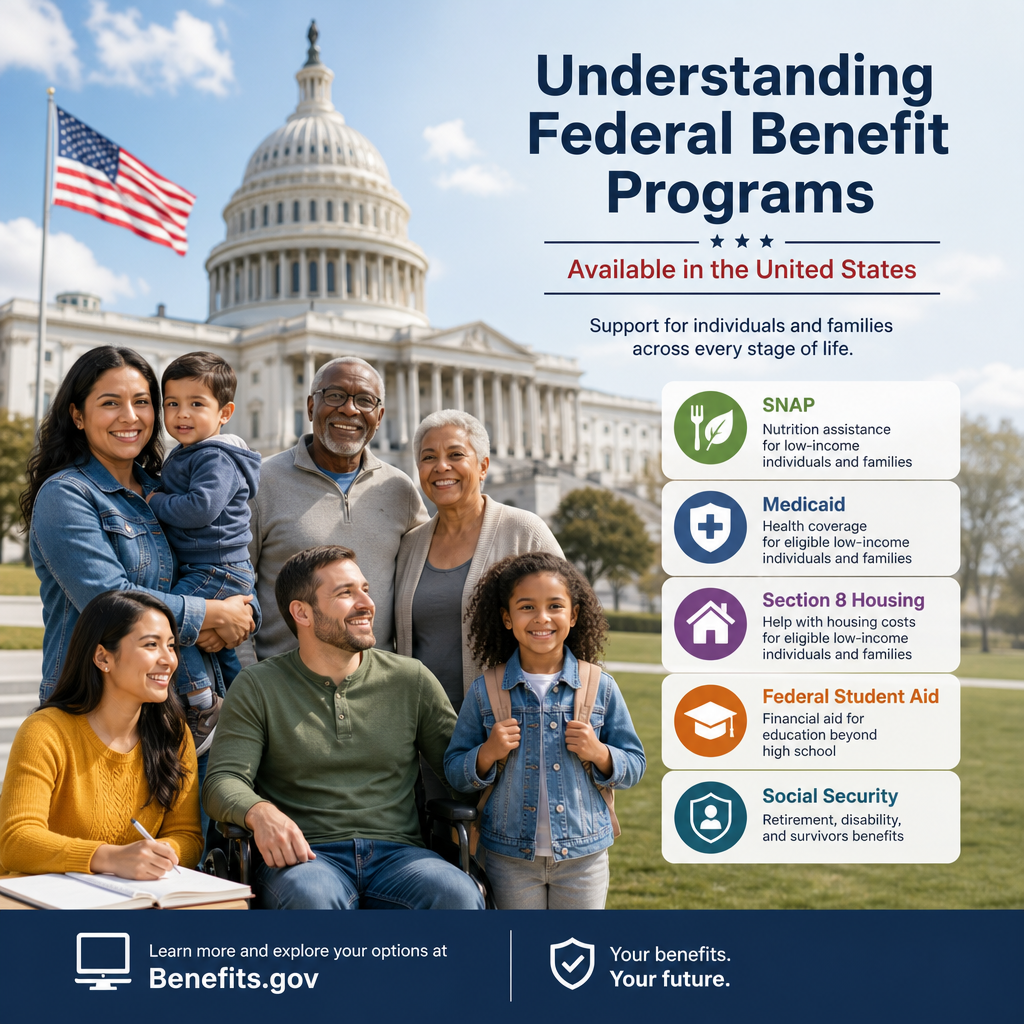
Understanding Federal Benefit Programs Available in the United States
Federal benefit programs help millions of people across the United States access food, health care, housing, income support, and more. This guide breaks down the most important programs so you can better understand what’s available and how they may help your household.
By: Emily Adams on julho 31, 2026
Federal benefit programs play a major role in helping millions of people across the United States meet basic needs, stay healthy, and build more stable lives. Whether someone is facing a temporary setback, planning for retirement, living with a disability, or supporting a low-income household, federal support programs can provide a meaningful safety net. Understanding how these programs work is the first step toward using them effectively.
In this guide, we’ll break down the most important federal benefit programs available in the United States, who they help, and how they fit into everyday life. If you’ve ever searched for information on federal benefit programs, this article will give you a practical overview without the confusion.
What Are Federal Benefit Programs?
Federal benefit programs are services or financial supports funded or administered by the U.S. government. Some are designed to help people with low income, while others support older adults, veterans, people with disabilities, children, or workers who have lost their jobs.
These programs generally fall into a few broad categories:
Income support
Health coverage
Food and nutrition assistance
Housing support
Retirement and disability benefits
Education and training assistance
Veterans benefits
Many programs are administered at the state or local level, even when the funding comes from the federal government. That means eligibility rules and application steps can vary depending on where you live.
Why Federal Benefit Programs Matter
Federal benefit programs are not just temporary aid. For many households, they are essential tools for maintaining stability during difficult times and for preparing for the future.
They can help people:
Afford food, medicine, and housing
Access medical care
Replace income after job loss
Support children’s health and nutrition
Cover education or training costs
Receive compensation after military service or workplace injuries
In short, these programs help reduce hardship and create a stronger foundation for long-term well-being.
Major Federal Benefit Programs in the United States
Social Security Retirement Benefits
Social Security is one of the best-known federal benefit programs. It provides monthly retirement income to eligible workers who paid into the system during their careers.
How it works
Workers earn credits over time by paying Social Security taxes. Once they reach retirement age and meet the required work history, they can begin receiving monthly payments.
Who it helps
Retired workers
Certain spouses and surviving family members
Key point
The amount you receive depends on your lifetime earnings and the age at which you begin claiming benefits. Claiming earlier usually means a smaller monthly check, while delaying may increase your benefit.
Social Security Disability Insurance (SSDI)
SSDI supports people who can no longer work because of a qualifying disability.
How it works
To qualify, a person generally must have worked long enough and recently enough to earn Social Security work credits. The disability must also meet the Social Security Administration’s definition of disability.
Who it helps
Workers with disabilities
Some family members of eligible workers
Important note
SSDI is based on work history, not financial need. That makes it different from other assistance programs such as Supplemental Security Income.
Supplemental Security Income (SSI)
SSI provides monthly payments to people with limited income and resources who are aged, blind, or disabled.
How it works
Unlike SSDI, SSI is need-based. It does not require a work history, though income and asset limits apply.
Who it helps
Older adults with limited income
Adults and children with disabilities
People who are blind and meet financial guidelines
Why it matters
SSI can help cover basic living expenses when other income sources are not enough.
Medicare
Medicare is the federal health insurance program for people age 65 and older, and for some younger people with disabilities or certain medical conditions.
Main parts of Medicare
Part A: Hospital coverage
Part B: Medical coverage
Part D: Prescription drug coverage
Medicare Advantage: Private plan alternatives approved by Medicare
Who it helps
Seniors
Some younger people with qualifying disabilities
People with End-Stage Renal Disease or certain other conditions
Practical example
A retiree may use Medicare Part A for a hospital stay, Part B for doctor visits, and Part D to lower prescription drug costs.
Medicaid
Medicaid is a joint federal and state program that helps cover medical costs for people with limited income.
How it works
The federal government sets broad rules, but each state runs its own Medicaid program within those guidelines.
Who it helps
Low-income adults
Children
Pregnant people
People with disabilities
Some older adults needing long-term care
Why it stands out
Medicaid often covers services that Medicare may not fully pay for, such as long-term care in some circumstances.
SNAP: Supplemental Nutrition Assistance Program
SNAP helps eligible individuals and families buy food.
How it works
Benefits are usually provided on an electronic benefits transfer card that can be used for groceries at approved retailers.
Who it helps
Low-income households
Seniors on fixed incomes
Families facing food insecurity
Common use case
A family dealing with reduced work hours may use SNAP benefits to stretch their grocery budget while getting back on their feet.
TANF: Temporary Assistance for Needy Families
TANF provides temporary financial assistance and related services to low-income families with children.
How it works
States receive federal funding and run their own TANF programs within federal rules. Benefits may include cash assistance, job training, and child care support.
Who it helps
Families with children who have limited income
Parents working toward self-sufficiency
Important detail
Because states have flexibility, benefit amounts and services vary widely.
Unemployment Insurance
Unemployment Insurance provides temporary income to eligible workers who lose their jobs through no fault of their own.
How it works
The program is managed by states, but federal law sets basic standards and funding structure.
Who it helps
Workers who were laid off
People who meet state wage and work requirements
Example
If a worker is laid off during a company downsizing, unemployment benefits can help cover bills while they search for a new job.
Housing Assistance Programs
Federal housing support can help reduce the cost of rent or improve access to safe housing.
Common types
Housing Choice Vouchers
Public housing
Project-based rental assistance
Who it helps
Low-income households
Seniors
People with disabilities
Families facing housing instability
What to know
Demand is often high, and waiting lists can be long. Eligibility usually depends on household income and family size.
WIC: Special Supplemental Nutrition Program for Women, Infants, and Children
WIC supports the health of pregnant people, new parents, infants, and young children.
How it works
The program provides nutrition education, healthy foods, breastfeeding support, and referrals to health care and social services.
Who it helps
Pregnant people
Postpartum parents
Infants
Children under age 5 who meet eligibility guidelines
Why it matters
WIC is designed to support healthy development during critical early stages of life.
Child Tax Credit and Other Tax-Based Supports
Some federal benefit programs work through the tax system rather than monthly checks.
Examples include:
Child Tax Credit
Earned Income Tax Credit (EITC)
Child and Dependent Care Tax Credit
Who they help
Working families
Low- and moderate-income taxpayers
Parents paying for child care
Practical value
These credits can reduce taxes owed or increase refunds, which may provide important financial relief during tax season.
Veterans Benefits
Veterans and their families may qualify for a wide range of federal benefits.
Common benefits include:
Health care through the Department of Veterans Affairs
Disability compensation
Education assistance
Home loan support
Burial and survivor benefits
Who it helps
Veterans
Eligible dependents and survivors
Why it matters
These programs recognize military service and help veterans transition to civilian life.
How to Know Which Federal Benefit Programs You May Qualify For
Eligibility depends on the program. Some are based on income, while others depend on age, work history, disability status, family size, military service, or immigration status.
Start by reviewing these factors:
Household income
Current employment status
Age
Disability or medical condition
Family composition
Residency and citizenship or immigration rules
Work credits or service history
A person may qualify for more than one program. For example, a low-income senior could receive Medicare, SNAP, and possibly SSI, depending on income and resources.
How to Apply for Federal Benefit Programs
The application process depends on the specific program, but there are some common steps.
1. Gather your documents
You may need:
Photo identification
Social Security number
Proof of income
Proof of address
Bank statements
Birth certificates
Medical records or disability documentation
Military service records
2. Check official eligibility rules
Always use official government sources to confirm requirements. Federal benefit programs often change, and state-administered programs may have different rules.
3. Apply through the correct agency
Applications may go through:
The Social Security Administration
Your state Medicaid or SNAP office
Your state unemployment office
The VA
The IRS
Local housing authorities
4. Follow up promptly
Some applications require interviews, additional paperwork, or periodic recertification. Delays can happen if documents are missing.
5. Appeal if needed
If your application is denied, you may have the right to appeal. Many programs have a formal review process.
Common Mistakes to Avoid
When applying for federal benefit programs, small errors can slow things down or affect eligibility.
Watch out for:
Using outdated forms or websites
Missing deadlines
Providing incomplete income information
Forgetting to report household changes
Assuming one program affects all others in the same way
Ignoring notices from the agency
A careful application can save time and reduce frustration.
How Federal Benefit Programs Work Together
One of the most helpful things to understand is that federal benefit programs can work together. They are not always either/or choices.
For example:
A retired person may receive Social Security and Medicare
A low-income family may use SNAP, WIC, and TANF
A disabled worker may qualify for SSDI and eventually Medicare
A veteran may receive VA health care and education benefits
This coordination can make a major difference in financial security and access to services.
The Role of State and Local Offices
Even though these are federal benefit programs, state and local agencies often handle applications, renewals, and day-to-day administration. That means your experience may differ depending on where you live.
Local offices can help with:
Application assistance
Eligibility questions
Document submission
Appeals and reviews
Referrals to other services
If you are unsure where to start, state or county human services offices are often a good first stop.
Frequently Asked Questions
1. What are the most common federal benefit programs in the United States?
Some of the most widely used federal benefit programs include Social Security, Medicare, Medicaid, SNAP, SSI, unemployment insurance, and veterans benefits. These programs support retirement income, health coverage, food access, disability support, and temporary financial help.
2. Can someone qualify for more than one federal benefit program?
Yes. Many people receive multiple benefits at the same time. For example, a low-income older adult might receive Social Security, Medicare, and SNAP. Eligibility rules vary, so it’s important to check how each program works individually.
3. Are federal benefit programs the same in every state?
Not always. Some programs, like Social Security and Medicare, are federal nationwide. Others, such as Medicaid, SNAP, TANF, and unemployment insurance, are administered by states under federal guidelines. That means benefits and application details can differ by location.
4. How do I apply for federal benefit programs?
You usually apply through the federal agency or your state’s administering office. For instance, Social Security benefits are handled by the Social Security Administration, while SNAP and Medicaid applications often go through state human services agencies. Always use official government websites or local offices.
5. What should I do if my application is denied?
If your application is denied, read the notice carefully and check the reason. Many federal benefit programs offer an appeal process. You may be able to submit more documents, request a hearing, or ask for a review. Deadlines are important, so respond quickly.
Federal benefit programs are a vital part of the American social safety net. They help people cover basic needs, recover from hardship, and plan for the future with more confidence. From Social Security and Medicare to SNAP, Medicaid, unemployment insurance, and veterans benefits, these programs serve different groups in different ways, but they all share one purpose: making essential support more accessible when people need it most.
The key to using federal benefit programs effectively is understanding which ones fit your situation, how eligibility works, and where to apply. Since many programs are managed through state agencies or have detailed requirements, taking time to verify information on official sources can save time and prevent mistakes.
If you or someone in your household may qualify, start by identifying the most relevant programs, gathering the needed documents, and reviewing the official application steps. Even one benefit can make a meaningful difference, and in many cases, combining several programs can provide a stronger foundation for stability and growth.
Emily A, holds a Master's degree in Public Administration (MPA) and has over 7 years of experience researching federal and state assistance programs. She writes educational content focused on government benefits, public policy, and community resources, using information from official agencies to help readers understand available programs and eligibility requirements.