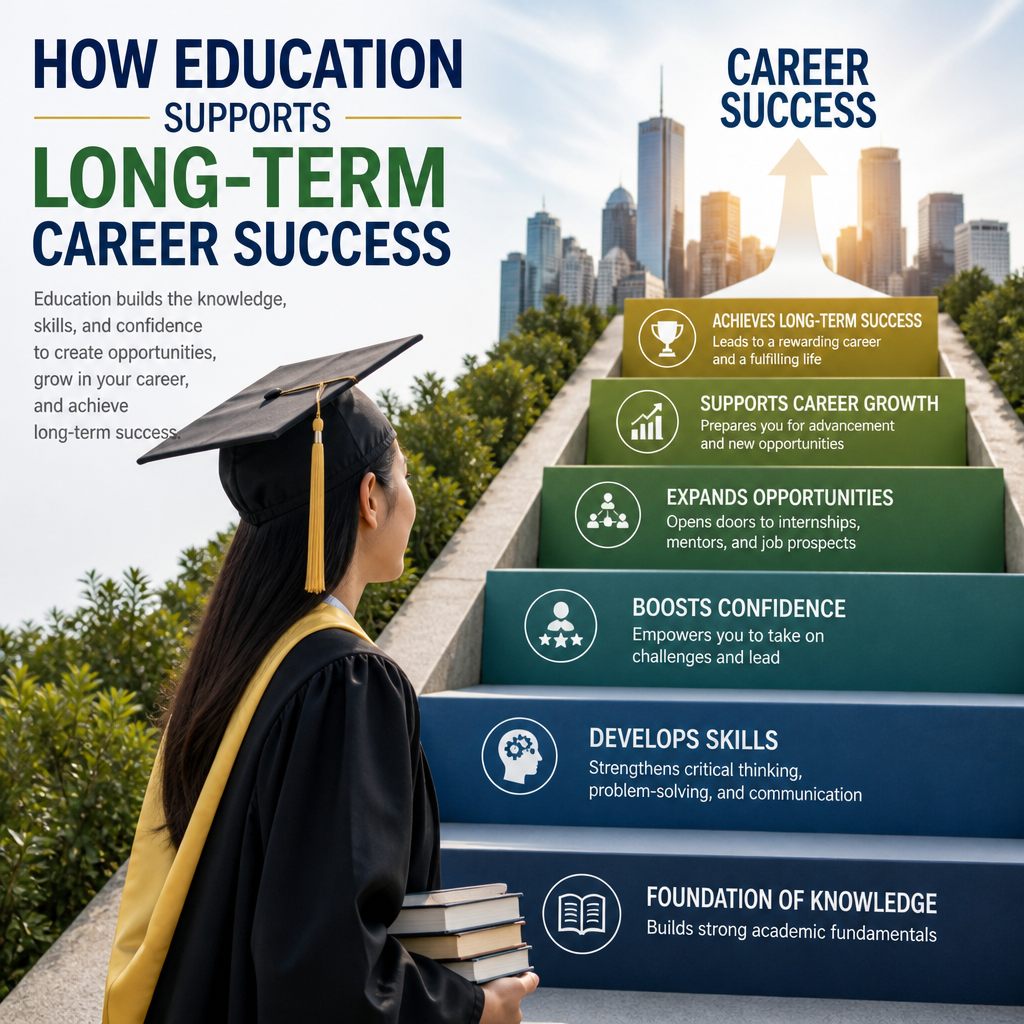
Education and career success go hand in hand, especially when learning helps people build the skills, confidence, and adaptability they need to grow over time. From stronger problem-solving to better job opportunities, education can create a foundation for long-term achievement in any field.
By: Jennifer Collins on julho 30, 2026
Education plays a much bigger role in career development than many people realize. It is not just about earning a diploma or checking a box for a first job. How education can support long-term career success is tied to the way it builds knowledge, strengthens problem-solving skills, improves adaptability, and opens doors to future opportunities.
In today’s changing job market, employers value people who can learn quickly, communicate clearly, and keep growing. A strong education helps develop those abilities early and gives professionals a foundation they can build on for years. Whether someone pursues a four-year degree, vocational training, certifications, or continuing education, learning can shape both short-term job prospects and long-term advancement.
How Education Can Support Long-Term Career Success
Education supports career success in several practical ways. It helps people qualify for jobs, prepare for industry changes, and gain the confidence to take on new responsibilities. It also creates habits that matter over time, such as discipline, curiosity, and persistence.
Education builds a strong knowledge base
Every career begins with understanding the basics. Education provides that starting point by teaching core concepts, industry standards, and technical skills.
For example:
A nurse needs clinical knowledge and communication skills.
An electrician needs technical training and safety awareness.
A business analyst needs data literacy and problem-solving skills.
This knowledge matters long after graduation. Employees who understand the foundation of their field are often better prepared to handle complex tasks, make informed decisions, and keep learning as their roles evolve.
It improves critical thinking and decision-making
One of the most valuable benefits of education is learning how to think, not just what to think. Classroom discussions, projects, labs, and assignments often require students to analyze information, compare options, and defend their conclusions.
Those habits carry over into the workplace.
People with strong critical thinking skills are more likely to:
Solve problems efficiently
Evaluate risks before acting
Adapt to new situations
Make better day-to-day decisions
This matters in every profession, from healthcare and engineering to sales and management.
Education increases career flexibility
Long-term career success rarely follows a straight line. Industries change, technology shifts, and job roles evolve. Education gives people more flexibility to move with those changes.
Someone with a broad academic or technical background may be able to:
Change roles within the same field
Pursue additional certifications
Move into leadership
Transition into a new industry
For instance, a person who studies communications may later work in marketing, public relations, content strategy, or nonprofit outreach. Education often creates that kind of flexibility by developing transferable skills.
Why Education Matters Beyond the First Job
Many people focus on education as a way to land an entry-level position. That is important, but the long-term value is even greater. Over time, education can influence salary growth, promotion potential, professional confidence, and the ability to stay relevant.
It supports promotion and advancement
Employers often look for more than experience when deciding who should move up. They also want people who can handle more responsibility, lead teams, and think strategically.
Education can help professionals qualify for advancement by:
Building technical expertise
Showing commitment to growth
Developing leadership and communication skills
Meeting requirements for specialized roles
In many industries, a degree or certification may not guarantee promotion, but it can strengthen a candidate’s profile and signal readiness for the next level.
It encourages lifelong learning
One of the clearest links between education and long-term career success is the habit of learning itself. People who continue to study, ask questions, and update their skills are often better positioned for long-term stability.
Lifelong learning can include:
Formal degree programs
Professional certifications
Workshops and seminars
Online courses
Industry conferences
Self-directed reading and practice
This mindset is especially important in fast-changing fields like technology, healthcare, finance, and digital marketing.
It helps professionals stay competitive
The modern workforce rewards people who can keep up. New software, changing regulations, and evolving customer expectations can make old skills outdated quickly. Education helps workers stay current and competitive.
A professional who keeps learning is better prepared to:
Use new tools and platforms
Understand updated best practices
Adapt to workplace changes
Remain valuable to employers
That kind of adaptability can make a major difference in long-term career stability.
The Role of Different Types of Education
Not every career path requires the same kind of education. The best path depends on a person’s interests, strengths, goals, and industry. What matters most is choosing a form of education that supports both immediate and future growth.
Traditional college degrees
For many careers, a college degree remains an important credential. It can provide broad knowledge, academic rigor, and access to professional networks.
A degree may be especially useful for careers in:
Education
Engineering
Healthcare
Business
Public administration
Social services
Beyond the credential itself, college often helps students build communication, teamwork, and research skills that remain useful throughout their careers.
Vocational and technical education
Trade schools and technical programs are excellent options for people who want practical, hands-on preparation. These programs often focus on job-ready skills and can lead to strong employment opportunities.
Examples include training for:
HVAC work
Welding
Automotive repair
Dental assisting
Medical coding
Computer support
Vocational education can support long-term career success by helping people enter the workforce faster while still building pathways for advancement.
Certifications and professional training
Certifications can strengthen a resume and show that a person has specialized knowledge. They are especially useful in fields where technology, regulations, or best practices change often.
Common examples include certifications in:
Project management
Information technology
Human resources
Accounting
Cybersecurity
Health and safety
These credentials can help professionals deepen expertise, increase credibility, and move into higher-level roles.
Continuing education and upskilling
Career growth does not end with a degree or certification. Many professionals benefit from continuing education throughout their careers.
Upskilling may involve learning:
New software
Leadership techniques
Data analysis tools
Compliance updates
Communication strategies
This ongoing learning helps people stay prepared for promotions, role changes, and new opportunities.
How Education Shapes Soft Skills
Technical knowledge matters, but long-term career success also depends on soft skills. Education often helps people develop these abilities in ways that are easy to overlook.
Communication
Students regularly practice written and verbal communication through essays, presentations, group projects, and discussions. In the workplace, those skills translate into clearer emails, better client interactions, and stronger teamwork.
Time management
Meeting deadlines, balancing assignments, and organizing coursework teaches people how to manage their time. That skill is extremely valuable in any profession where priorities shift and responsibilities overlap.
Collaboration
Group work prepares students to collaborate with people who have different perspectives, working styles, and strengths. That experience is useful in modern workplaces, where teamwork often drives success.
Resilience
Education often includes challenges: difficult classes, tight deadlines, and moments of frustration. Learning to push through those experiences builds resilience, which is essential for handling career setbacks and pressure.
Practical Ways to Use Education for Career Growth
Education works best when people apply it strategically. A degree or certificate is more valuable when paired with practical action.
Connect learning to career goals
Before enrolling in a program or course, think about where you want your career to go. Ask:
What kind of work do I want to do?
Which skills are most important in that field?
What credentials do employers value?
What gaps do I need to fill?
Clear goals make it easier to choose the right type of education.
Build experience alongside education
Work experience matters. Internships, apprenticeships, volunteer work, and part-time jobs can help people apply what they learn and build a stronger resume.
For example, a student studying marketing might also:
Manage social media for a local business
Join a campus organization
Freelance on small projects
Complete a summer internship
This combination of education and experience often leads to stronger long-term outcomes.
Keep your skills updated
Even after starting a career, set aside time for growth. Read industry news, attend webinars, take short courses, and look for opportunities to learn from mentors.
A few simple habits can help:
Review your skills every six months.
Identify emerging tools or trends in your field.
Add one new learning goal each quarter.
Track certifications or training you complete.
Update your resume and portfolio regularly.
Network through educational opportunities
Education can also support career success by expanding your professional network. Classmates, instructors, alumni, and guest speakers may become valuable contacts later.
Networking through education can lead to:
Job referrals
Mentorship
Industry insight
Collaboration opportunities
These relationships often become especially useful when changing jobs or pursuing new directions.
Common Misunderstandings About Education and Career Success
It is easy to assume that education guarantees success, but that is not always true. Education is powerful, but it works best when paired with effort, experience, and good decision-making.
A degree is not the only path
Some people think long-term career success requires a traditional college degree. That is not always the case. Many successful professionals build careers through trade programs, certifications, and practical experience.
Education is not enough by itself
A strong educational background can open doors, but it does not replace work ethic, professionalism, or adaptability. People still need to show up, perform well, and keep learning.
Career success can look different for everyone
For one person, success may mean leadership and high earnings. For another, it may mean stability, flexibility, or meaningful work. Education can support all of those goals, but the path will look different depending on the individual.
Frequently Asked Questions
1. How does education help with long-term career success?
Education helps with long-term career success by building knowledge, improving problem-solving skills, and preparing people to adapt to change. It also supports promotions, career flexibility, and lifelong learning.
2. Is a college degree necessary for career success?
Not always. Many careers require a degree, but others value certifications, trade training, apprenticeships, and hands-on experience. The best path depends on the field and your personal goals.
3. How can education improve job opportunities?
Education can make candidates more competitive by showing employers they have relevant skills and training. It can also help people qualify for more positions and pursue specialized roles.
4. What skills gained through education matter most at work?
Some of the most important skills include communication, critical thinking, time management, teamwork, adaptability, and problem-solving. These skills help in almost every profession.
5. How can someone keep learning after finishing school?
People can keep learning by taking online courses, earning certifications, attending workshops, reading industry publications, and seeking mentorship. Continuous learning helps professionals stay current and grow over time.
Education is one of the most reliable tools for building a strong and adaptable career. It does more than prepare people for their first job. It helps them develop the knowledge, confidence, and habits needed to grow over time. Whether someone chooses a college degree, trade training, certification, or ongoing professional development, education can create a foundation for long-term progress.
The strongest careers are often built by people who keep learning. They update their skills, adapt to change, and look for ways to improve. That is why how education can support long-term career success matters so much: it is not just about earning credentials, but about creating momentum that lasts.
If you are planning your own path, think beyond the immediate job search. Focus on the skills you want to build, the opportunities you want to reach, and the kind of future you want to create. Education can help you get there, one step at a time.
Jennifer, M.Ed., holds a degree in Higher Education Administration, with
a focus on U.S. college financial aid, admissions policy, and student
support systems. She researches and writes about scholarships, federal
aid programs, and the college planning process to help students and
families make informed, well-supported decisions.