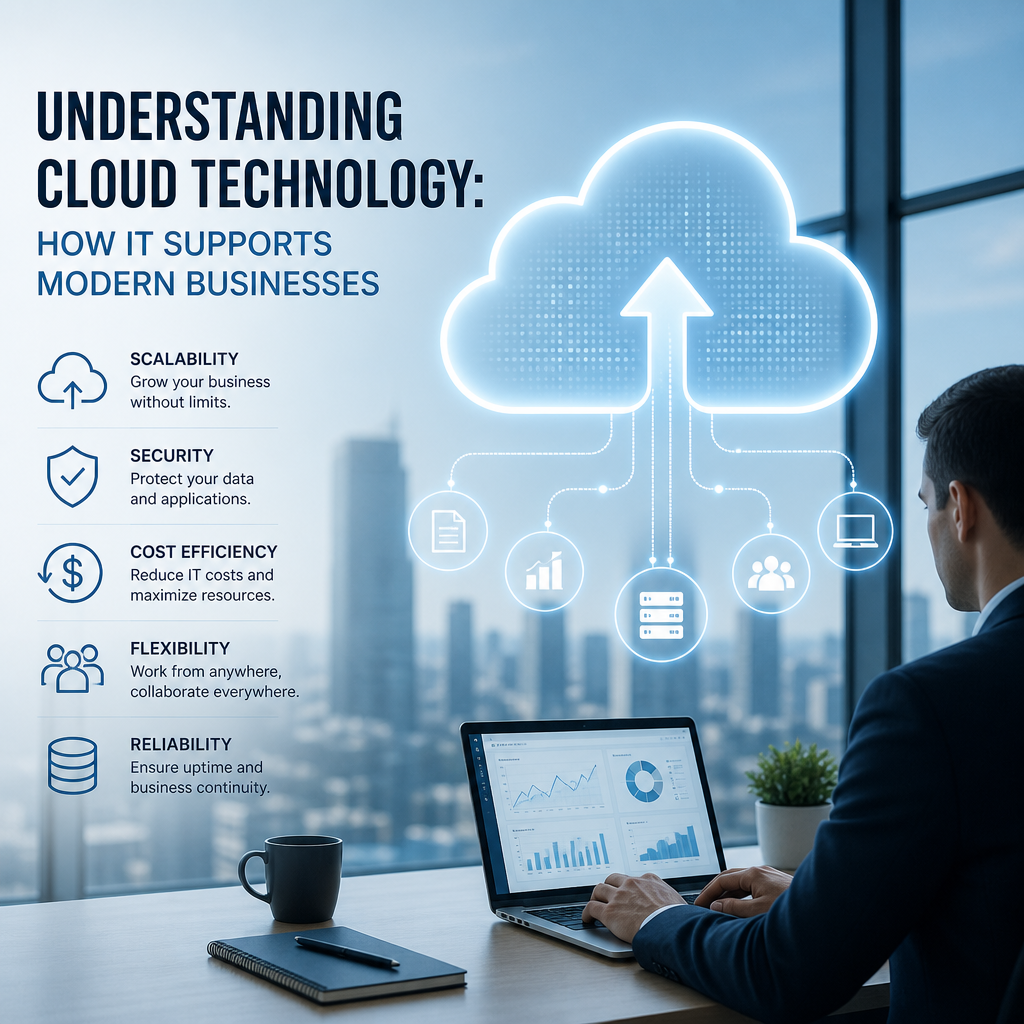
Understanding Cloud Technology: How It Supports Modern Businesses
Cloud technology is helping businesses work faster, scale more easily, and reduce the burden of managing physical infrastructure. In this article, we’ll explore how cloud technology works and why it has become a practical foundation for modern companies.
By: Peter B on julho 30, 2026
Cloud technology has changed the way companies work, store data, and deliver services. Instead of relying entirely on local servers and physical hardware, businesses now use internet-based computing to access applications, storage, and infrastructure on demand. For many organizations, cloud technology is no longer a future trend—it is a practical foundation for growth, flexibility, and resilience.
Whether you run a small business or manage a large enterprise, understanding cloud technology can help you make smarter decisions about efficiency, security, and scalability. In this article, we’ll break down what cloud technology is, how it works, and why it plays such an important role in modern business operations.
What Is Cloud Technology?
Cloud technology refers to the delivery of computing services over the internet. These services can include:
Data storage
Software applications
Servers and computing power
Databases
Networking tools
Artificial intelligence and analytics platforms
Instead of installing everything on a local device or maintaining physical servers in-house, businesses access these services through a cloud provider. This model gives organizations more flexibility and often reduces the need for large upfront technology investments.
In simple terms, cloud technology allows businesses to use what they need, when they need it, without managing all the underlying infrastructure themselves.
How Cloud Technology Works
Cloud systems rely on remote data centers operated by cloud providers. These providers maintain the hardware, software, and security controls needed to deliver services to customers over the internet.
Common cloud service models
There are three primary types of cloud services:
1. Infrastructure as a Service (IaaS)
IaaS provides access to core computing resources such as virtual machines, storage, and networking. Businesses can build and manage their own systems on top of this infrastructure.
Example: A company that wants to host a custom application may use cloud servers instead of buying physical machines.
2. Platform as a Service (PaaS)
PaaS gives developers a platform for building, testing, and deploying applications without managing the underlying infrastructure.
Example: A software team can focus on writing code while the cloud platform handles runtime, updates, and scaling.
3. Software as a Service (SaaS)
SaaS delivers complete software applications over the internet, usually through a web browser or app.
Example: Email platforms, customer relationship management tools, and collaboration software are all commonly delivered as SaaS.
Deployment models
Businesses also choose different cloud deployment models based on their needs:
Public cloud: Shared infrastructure managed by a provider
Private cloud: Dedicated cloud environment used by one organization
Hybrid cloud: Combination of public and private cloud systems
Multi-cloud: Use of services from more than one cloud provider
Each model offers different advantages depending on cost, security requirements, and operational goals.
Why Cloud Technology Matters for Modern Businesses
Cloud technology supports modern businesses in many practical ways. It helps teams work faster, adapt more easily, and stay competitive in a changing marketplace.
Cloud Technology and Business Agility
One of the biggest advantages of cloud technology is agility. Businesses can launch new tools, expand into new markets, or adjust resources quickly without waiting for lengthy hardware purchases or installation projects.
Faster deployment
With cloud-based systems, businesses can often set up environments in minutes or hours rather than weeks. That speed is especially useful for:
Product launches
Seasonal demand spikes
Remote team expansion
Testing new services
Easier experimentation
Cloud technology also makes it easier to test ideas without taking on major risk. A company can build a pilot program, evaluate results, and scale up only if the project proves valuable.
For example, a retailer might use cloud analytics to test a new recommendation engine before rolling it out across its entire online store.
Cost Efficiency and Resource Optimization
Cloud technology can help businesses spend more strategically. Instead of buying and maintaining large amounts of hardware upfront, organizations often pay for what they use.
Lower infrastructure burden
Traditional IT environments require businesses to manage:
Server maintenance
Hardware upgrades
Data center space
Cooling and power costs
Backup systems
Cloud providers handle much of that infrastructure responsibility, which can free internal IT teams to focus on higher-value work.
Better resource allocation
Because cloud services scale based on demand, businesses avoid paying for unused capacity. This is especially helpful for organizations with variable workloads.
Practical example:
An accounting firm may need heavy computing resources during tax season but much less the rest of the year. Cloud technology allows the firm to increase resources when needed and scale back later.
Scalability for Growth
Growth is a good problem to have, but it can create major technical challenges if systems are not built to scale. Cloud technology supports modern businesses by making expansion easier.
Scale up or down on demand
Cloud resources can often be adjusted automatically or with minimal effort. That means a business can:
Handle increased website traffic
Add users to internal software
Expand storage for growing data volumes
Support new locations or teams
This flexibility is especially valuable for startups and fast-growing companies that need to stay responsive without overbuilding early on.
Support for global operations
Cloud technology also helps businesses serve customers and teams across different regions. Cloud providers often operate data centers in multiple locations, which can improve performance and reliability for distributed workforces.
Cloud Technology and Remote Work
Remote and hybrid work have become a normal part of business operations for many organizations. Cloud technology plays a central role in making that possible.
Access from anywhere
Cloud-based tools allow employees to access files, applications, and systems from office desktops, laptops, tablets, or mobile devices. This supports productivity no matter where team members are located.
Better collaboration
Teams can work together in real time using:
Shared documents
Project management platforms
Video conferencing tools
Cloud storage and file sharing
Instead of emailing multiple versions of a file back and forth, employees can collaborate in one shared environment and reduce confusion.
Security and Data Protection in the Cloud
Security is one of the most important considerations when adopting cloud technology. Many businesses worry about moving sensitive data to the cloud, but reputable cloud providers invest heavily in security controls.
Shared responsibility matters
Cloud security works on a shared responsibility model. The provider secures the cloud infrastructure, while the business is responsible for how it configures and uses the services.
That means businesses still need to pay attention to:
Strong passwords and multi-factor authentication
User access controls
Data classification
Software updates
Employee training
Common security benefits
Cloud technology can improve security in several ways:
Centralized control over access and permissions
Automated backups and disaster recovery options
Encryption for data at rest and in transit
Continuous monitoring and threat detection
Faster patching and updates
Best practices for businesses
To use cloud technology safely, businesses should:
Choose reputable providers with strong compliance standards
Apply least-privilege access to reduce risk
Use multi-factor authentication for all critical systems
Back up important data regularly
Train employees to recognize phishing and other threats
Cloud security is not automatic, but it can be very strong when managed carefully.
Cloud Technology Supports Business Continuity
Every business needs a plan for unexpected events. Natural disasters, hardware failures, cyber incidents, and power outages can disrupt operations. Cloud technology helps businesses stay resilient.
Disaster recovery
Cloud-based backup and recovery systems make it easier to restore data and services after an interruption. Instead of relying only on local devices or office servers, companies can store backups in secure remote environments.
Business continuity
If a workplace becomes inaccessible, cloud tools allow teams to continue working from another location. That ability can reduce downtime and protect customer service, productivity, and revenue.
For many modern businesses, cloud technology is a key part of continuity planning.
Data, Analytics, and Smarter Decision-Making
Today’s businesses generate a lot of data. Cloud technology makes it easier to store, process, and analyze that information at scale.
Centralized data access
With cloud platforms, businesses can bring together data from different departments and systems. That creates a clearer view of operations, customer behavior, and performance trends.
Better reporting and insights
Cloud analytics tools can help leaders:
Track sales performance
Monitor customer engagement
Forecast demand
Identify operational bottlenecks
Improve marketing campaigns
Example:
A restaurant chain might analyze online ordering patterns in the cloud to adjust staffing, inventory, and promotions by location.
Support for AI and automation
Cloud technology also powers many modern AI and automation tools. Businesses can use these capabilities to streamline repetitive work, improve customer support, and uncover insights that would be difficult to identify manually.
Industries That Benefit from Cloud Technology
Cloud technology supports nearly every industry, but some sectors rely on it especially heavily.
Retail
Retailers use cloud systems for e-commerce, inventory management, customer data, and personalized marketing.
Healthcare
Healthcare organizations use cloud platforms for data sharing, record management, telehealth, and secure communication, while following strict compliance rules.
Finance
Banks and financial firms use cloud technology for analytics, fraud monitoring, customer service, and secure transaction processing.
Manufacturing
Manufacturers use cloud-based tools to monitor supply chains, manage production systems, and connect distributed facilities.
Professional services
Law firms, accounting firms, marketing agencies, and consultancies use cloud technology to collaborate with clients, store files securely, and manage projects efficiently.
Challenges Businesses Should Consider
While cloud technology offers many benefits, it is not a one-size-fits-all solution. Businesses should evaluate both advantages and trade-offs before moving workloads to the cloud.
Internet dependence
Cloud systems rely on internet access. If connectivity is poor or interrupted, access to cloud tools may be affected.
Ongoing management
Even though cloud providers handle much of the infrastructure, businesses still need internal policies, governance, and technical oversight.
Cost control
Cloud costs can grow if usage is not monitored carefully. Without proper budgeting, businesses may pay for resources they do not fully use.
Vendor lock-in
Some organizations find it difficult to switch providers later because of technical dependencies or data migration challenges. Careful planning can reduce this risk.
How to Get Started with Cloud Technology
If your business is considering cloud adoption, a thoughtful approach can make the transition smoother.
1. Identify business goals
Start by asking what you want cloud technology to solve. Do you need better collaboration, lower infrastructure costs, stronger disaster recovery, or faster application development?
2. Review your current systems
Look at your existing software, data, and workflows. Some systems may move to the cloud easily, while others may require customization or a hybrid setup.
3. Choose the right service model
Select IaaS, PaaS, SaaS, or a combination based on your technical needs and internal resources.
4. Plan for security and compliance
Make sure your cloud strategy supports relevant legal, industry, and internal requirements.
5. Train your team
Employees need to understand how to use cloud tools securely and effectively. Training improves adoption and reduces mistakes.
6. Monitor and improve
Cloud adoption is not a one-time event. Review performance, costs, and user feedback regularly so you can optimize over time.
Frequently Asked Questions
What is cloud technology in simple terms?
Cloud technology is the use of internet-based services for storage, software, and computing power instead of relying only on local devices or in-house servers. It allows businesses to access what they need remotely and scale resources as needed.
Is cloud technology only for large businesses?
No. Cloud technology is useful for businesses of all sizes. Small businesses often benefit from lower upfront costs and easy access to professional-grade tools, while larger organizations value scalability, security, and global reach.
Is cloud storage secure?
Cloud storage can be secure when businesses choose trusted providers and use proper security practices. Strong passwords, multi-factor authentication, access controls, encryption, and regular backups all help protect data.
What is the difference between cloud and traditional IT?
Traditional IT depends on local hardware and software managed on-site. Cloud technology delivers those resources over the internet, which often provides more flexibility, faster deployment, and easier scaling.
How does cloud technology help remote teams?
Cloud technology gives remote teams access to shared files, applications, and communication tools from anywhere with an internet connection. This makes collaboration easier and helps employees stay productive across different locations.
Cloud technology has become a practical engine for modern business success. It helps organizations move faster, collaborate better, protect data, and respond more effectively to change. From SaaS apps that simplify daily work to cloud infrastructure that supports growth and disaster recovery, the benefits extend across departments and industries.
The real value of cloud technology is not just in reducing IT complexity. It is in enabling businesses to be more agile, resilient, and data-driven. Companies that use the cloud strategically can improve operations today while building a stronger foundation for tomorrow.
If your business is still relying heavily on traditional systems, now is a smart time to evaluate where cloud technology can make the biggest impact. Start with one business goal, assess your current needs, and build a plan that supports both security and growth. The cloud is not just a technical upgrade—it is a way to create more responsive, efficient, and competitive organizations.
Peter B holds a degree in Journalism and has 5 years of experience covering U.S. economic policy, labor markets, and financial news. He writes data-driven news content on topics like inflation, interest rates, and employment trends.