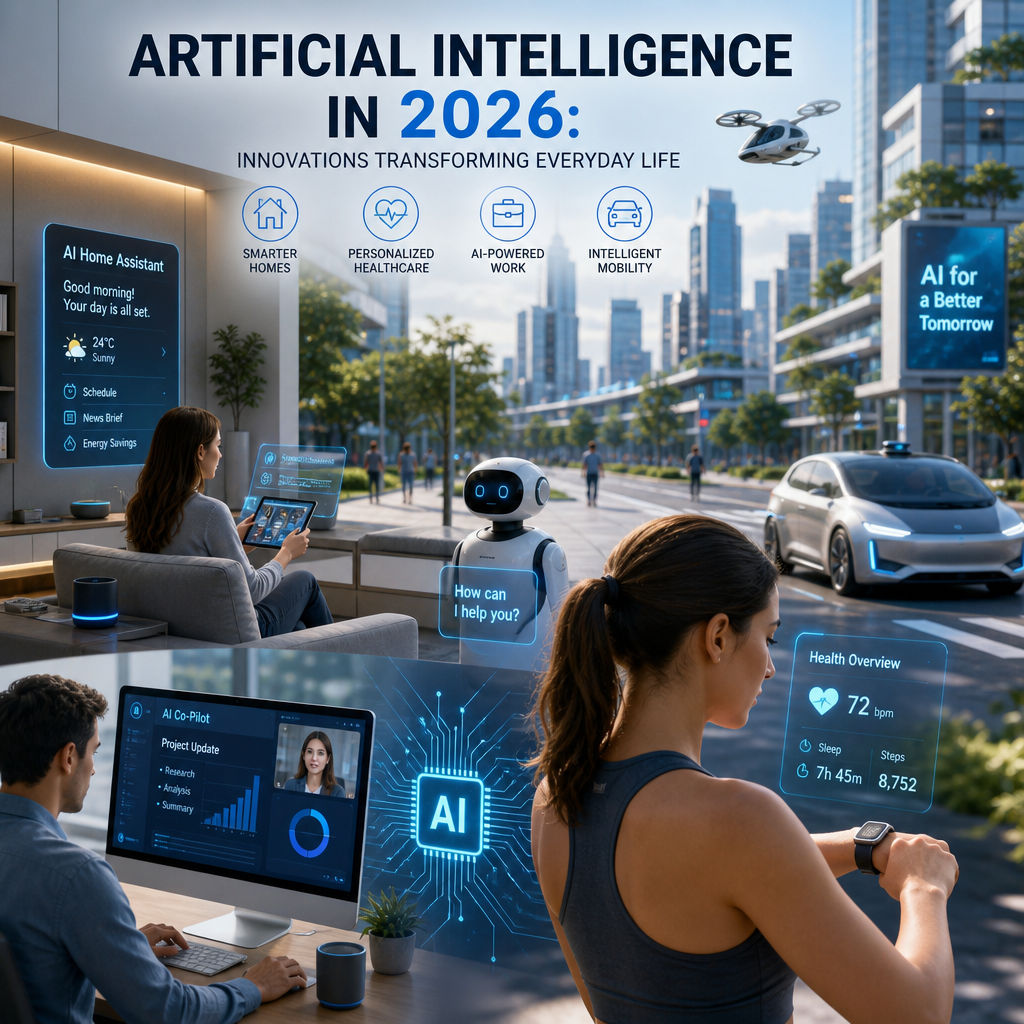
Artificial Intelligence in 2026: Innovations Transforming Everyday Life
Artificial intelligence in 2026 is becoming a seamless part of everyday life, quietly helping people work faster, make smarter decisions, and simplify routine tasks. From personalized health support to smarter shopping and travel, these innovations are making AI more practical, conversational, and useful than ever.
By: Peter B on julho 30, 2026
Artificial intelligence in 2026 is no longer something people only encounter in labs, headlines, or sci-fi stories. It has become part of daily routines in ways that feel practical, useful, and increasingly normal. From the way we work and shop to how we manage health, travel, and home life, AI is shaping ordinary decisions with less friction and more personalization.
What makes artificial intelligence in 2026 especially important is not just that it is smarter. It is more integrated, more conversational, more context-aware, and more capable of supporting people in real time. The most valuable systems now do more than generate text or answer questions. They help users act, organize, predict, automate, and adapt.
This article explores the biggest AI innovations transforming everyday life in 2026, with a focus on what they mean for real people—not just tech insiders.
Artificial Intelligence in 2026 Is More Useful, Not Just More Powerful
For years, AI improvements were measured by benchmarks and technical breakthroughs. In 2026, the more meaningful metric is usefulness. The best AI tools are quietly blending into familiar experiences.
From novelty to daily utility
Many people no longer think of AI as a separate product. Instead, it shows up inside the tools they already use:
Email apps that summarize long threads
Navigation systems that adjust routes based on live conditions
Search tools that answer questions in natural language
Smart assistants that handle scheduling, reminders, and follow-ups
Health platforms that personalize care suggestions
This shift matters because adoption grows when AI saves time, reduces stress, or helps people make better decisions without requiring a steep learning curve.
Why the user experience has improved
In 2026, AI systems are better at understanding:
Natural language requests
Visual input, such as photos and scanned documents
Voice commands with context
Personal preferences over time
Multi-step tasks that require planning
As a result, people can interact with AI in a more human way. They do not have to learn complicated commands or jargon. They simply explain what they need.
AI Assistants Are Becoming True Personal Coordinators
One of the clearest changes in artificial intelligence in 2026 is the rise of advanced AI assistants that do more than answer questions. These tools now function like digital coordinators.
Managing schedules, tasks, and follow-through
Modern assistants can:
Review a calendar and suggest better meeting times
Draft responses to routine emails
Track action items after a meeting
Remind users of deadlines based on prior conversations
Prepare a daily agenda that adapts as plans change
This is especially helpful for professionals, students, caregivers, and busy households. Instead of juggling multiple apps manually, people can rely on AI to connect the dots.
Practical example: planning a family week
Imagine a parent with work meetings, a child’s sports practice, and a doctor appointment. An AI assistant can help by:
Finding open time slots
Proposing an efficient route between locations
Sending reminders for needed documents or supplies
Rescheduling a less urgent task if a conflict appears
The goal is not to replace human decision-making. It is to reduce the mental load that comes with managing everyday complexity.
AI in Health and Wellness Is More Personalized
Healthcare has always been a promising area for AI, but in 2026 the most visible changes are happening in wellness tracking, early support, and better communication between patients and providers.
Smarter monitoring and early alerts
Wearables and connected health apps now use AI to identify patterns in:
Sleep quality
Heart rate trends
Activity levels
Stress indicators
Medication routines
These tools can flag changes that may deserve attention. That does not mean they diagnose illness on their own, but they can encourage people to seek professional help sooner when something looks unusual.
Better support between appointments
AI is also improving the patient experience by helping users:
Understand medical instructions in plain language
Prepare questions before a doctor visit
Track symptoms over time
Follow treatment plans more consistently
Organize health records and appointment notes
For many people, this makes healthcare feel less overwhelming. It also supports better communication, which can improve outcomes and trust.
Caution still matters
Even with these improvements, people should remember that AI health tools are not a substitute for licensed medical advice. The best use of AI in 2026 is as a support layer—something that helps users stay informed and organized while working with qualified professionals.
Smarter Homes Are Becoming More Adaptive
The smart home has matured significantly. In 2026, connected devices are more aware of routines, preferences, and environmental conditions. Rather than simply responding to commands, they anticipate needs.
Everyday convenience with less effort
AI-powered home systems can now assist with:
Adjusting lighting based on time of day
Learning temperature preferences
Identifying unusual energy use
Suggesting appliance settings
Coordinating security and delivery alerts
For example, a home system might lower the thermostat before bedtime, turn on lights when someone enters a room, and alert the homeowner if a door is left open.
Energy savings through intelligent automation
Many families are using AI to better manage electricity, heating, and cooling. Smart systems can analyze patterns and recommend changes that support comfort and efficiency. They can also help users avoid waste by turning off devices that are not needed.
This is one of the most practical examples of artificial intelligence in 2026 because it affects both convenience and cost management.
AI Is Changing How People Shop and Make Buying Decisions
Shopping has become more personalized, more conversational, and more efficient thanks to AI. Whether someone is buying groceries, clothes, electronics, or household supplies, AI tools now shape the experience from discovery to checkout.
Personalized recommendations that feel less random
Instead of showing generic suggestions, AI systems can learn preferences such as:
Preferred brands
Size and fit history
Budget range
Dietary needs
Buying frequency
That means users spend less time scrolling and more time deciding what actually fits their needs.
Comparison shopping is easier
AI can now help shoppers compare products by summarizing key differences, highlighting tradeoffs, and pointing out practical details. For example, a user comparing two laptops may want to know:
Battery life
Weight
Performance for everyday tasks
Warranty support
Value for the price
A well-designed AI assistant can present that information in a clear format, saving time and reducing decision fatigue.
Customer service is faster and more helpful
Businesses are using AI chat systems to respond to common questions, process returns, and guide users through product setup. When done well, this improves customer satisfaction because people get faster answers without waiting on hold.
AI in Transportation Is Making Travel More Efficient
Transportation is another area where artificial intelligence in 2026 is having a visible effect. From route optimization to driver support, AI is helping people travel more safely and efficiently.
Navigation that thinks ahead
AI-powered maps and travel apps now consider more than just distance. They can account for:
Traffic patterns
Weather
Construction
Event congestion
Time-sensitive appointments
That helps travelers avoid delays and make better choices in real time.
Driver assistance is becoming more advanced
Many modern vehicles use AI to support safety features such as:
Lane monitoring
Collision warnings
Adaptive cruise control
Parking assistance
Attention alerts
These tools do not replace the driver, but they can reduce strain and help prevent common mistakes.
Public transit and logistics are improving too
AI is also helping transit systems and delivery networks operate more efficiently. When schedules, demand, and route planning improve, everyday users benefit from better service and fewer disruptions.
Work and Education Are Becoming More Flexible
AI is changing how people learn, create, and solve problems in both professional and academic settings. The biggest shift is not automation alone. It is accessibility.
AI helps people work faster and think more clearly
In offices and remote work environments, AI is often used for:
Drafting emails and reports
Summarizing meetings
Translating documents
Organizing research
Generating outlines for presentations
This gives people more time to focus on strategy, creativity, and human judgment.
Learning support is more individualized
In education, AI tools can adapt to a learner’s pace and style. Students can get help with:
Practice quizzes
Reading support
Writing feedback
Vocabulary building
Study plans based on weak areas
Teachers also use AI to reduce administrative tasks and provide more tailored instruction. When used responsibly, these tools can make learning more flexible and inclusive.
A healthy balance is still important
AI can support productivity and learning, but it should not replace critical thinking. In 2026, one of the most important skills is knowing how to use AI well while still checking facts, evaluating sources, and applying human judgment.
Creative Tools Are Expanding What Everyday People Can Make
Artificial intelligence in 2026 is also transforming creative work. You no longer need to be a professional designer, editor, or musician to experiment with high-quality creative tools.
Creativity is becoming more accessible
AI can help users:
Edit photos and videos
Generate visual concepts
Draft marketing copy
Create music ideas
Build simple websites
Refine writing for tone and clarity
This lowers barriers for small businesses, freelancers, hobbyists, and creators who want to produce polished work without large budgets.
Real-world use for small businesses
A local bakery, for example, may use AI to:
Write social media captions
Create seasonal promotions
Design menu graphics
Answer customer questions
Analyze which posts perform best
This gives smaller organizations access to capabilities that once required larger teams.
Privacy, Trust, and Responsible Use Matter More Than Ever
As AI becomes more embedded in daily life, people are paying closer attention to how their data is used and how systems make decisions.
Why trust is a central issue
The more personal an AI system becomes, the more important it is that it:
Protects user data
Explains decisions clearly
Avoids misleading output
Gives users control over settings
Follows safety and compliance standards
People are more likely to adopt AI when they understand what it is doing and can choose how much it participates in their lives.
Good habits for everyday users
To use AI responsibly, people should:
Review privacy settings regularly
Avoid sharing sensitive information unnecessarily
Verify important facts from trusted sources
Treat AI-generated advice as a starting point, not a final answer
Use tools from reputable providers with clear policies
Responsible use helps users get the benefits of AI without giving up control.
What Artificial Intelligence in 2026 Means for the Future
The most important thing about artificial intelligence in 2026 is that it is no longer only about what AI can do in theory. It is about how it is quietly improving ordinary life.
Across homes, workplaces, schools, cars, and mobile devices, AI is helping people:
Save time
Reduce mental clutter
Make smarter choices
Access personalized support
Create more efficiently
The future of AI is not one giant leap. It is a steady accumulation of practical improvements that make everyday life smoother and more responsive.
Frequently Asked Questions
1. What makes artificial intelligence in 2026 different from earlier years?
Artificial intelligence in 2026 is more integrated into daily tools and more capable of handling real tasks. Instead of only generating text or answering simple questions, many AI systems now help with scheduling, shopping, health tracking, navigation, and creative work. They are more conversational, context-aware, and useful in everyday settings.
2. Is AI in 2026 safe to use for personal information?
It can be, but users should stay cautious. The safest approach is to use reputable platforms, review privacy settings, and avoid sharing highly sensitive information unless necessary. AI tools should be treated as helpful assistants, not as places to store information you would not want exposed.
3. How is AI improving home life in 2026?
AI is making homes more adaptive and efficient. Smart systems can adjust lighting, temperature, security alerts, and energy use based on routines and conditions. This reduces manual effort and can help homeowners feel more comfortable and organized.
4. Can AI really help with health and wellness?
Yes, AI can help track patterns, organize health information, and support better communication with healthcare professionals. It is useful for reminders, symptom tracking, and understanding instructions. However, it should not replace medical advice from licensed providers.
5. Will AI replace human jobs and decision-making completely?
No, AI is more likely to change how people work than to replace human judgment entirely. It can automate repetitive tasks, speed up analysis, and support decision-making, but humans still play the key role in context, ethics, creativity, and accountability.
Artificial intelligence in 2026 is transforming everyday life in ways that are practical, visible, and increasingly indispensable. It is helping people manage time, improve health routines, make smarter purchases, navigate travel, support learning, and simplify home life. Just as important, AI is becoming easier to use because it understands natural language, adapts to context, and fits into the tools people already rely on.
The biggest opportunity is not simply having more advanced technology. It is using AI thoughtfully to reduce friction and improve the quality of daily decisions. At the same time, responsible use matters. People should pay attention to privacy, verify important information, and choose trustworthy tools that put user control first.
As AI continues to evolve, the best approach is to stay informed and stay curious. Learn what these tools can do, explore where they genuinely save time, and use them in ways that support your goals rather than distract from them. The future of AI is already here—and the people who benefit most will be the ones who know how to use it well.
Peter B holds a degree in Journalism and has 5 years of experience covering U.S. economic policy, labor markets, and financial news. He writes data-driven news content on topics like inflation, interest rates, and employment trends.