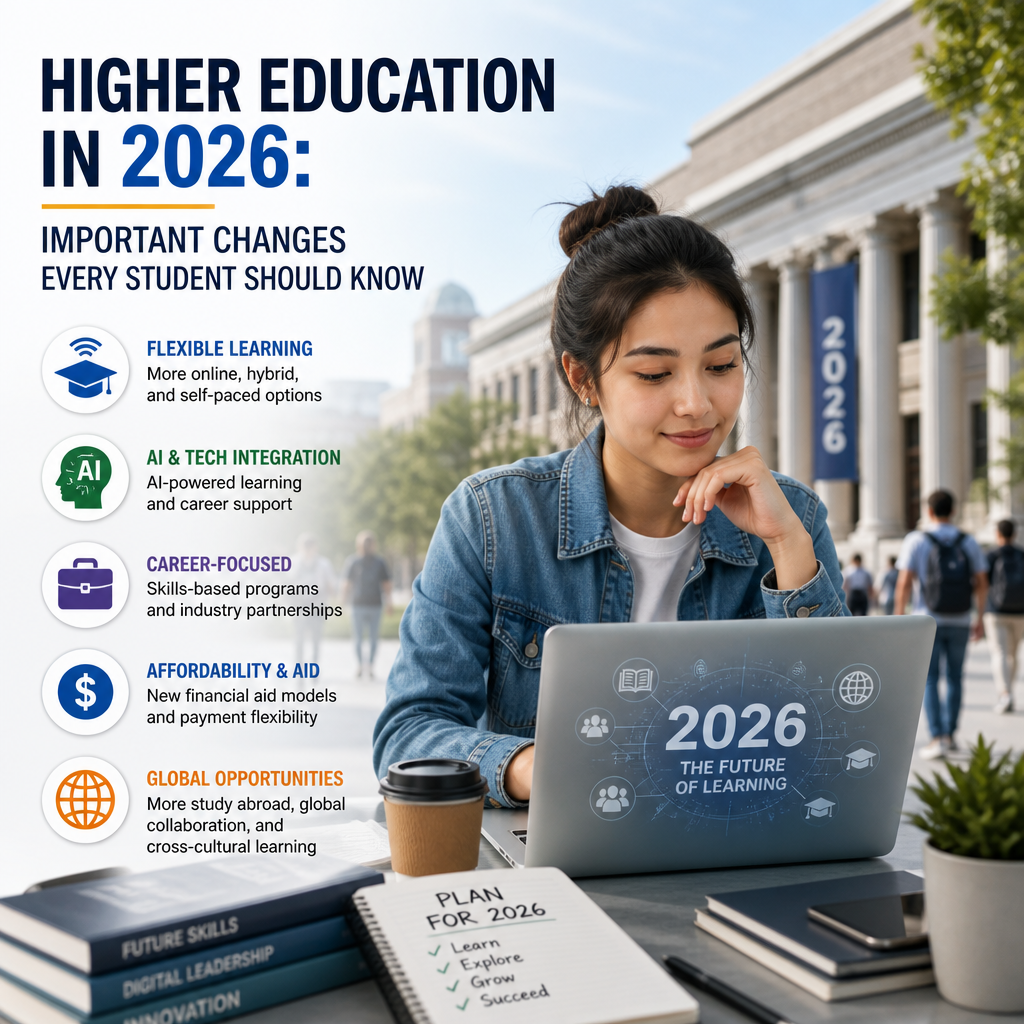
Higher Education in 2026: Important Changes Every Student Should Know
Higher education in 2026 is evolving fast, with AI, affordability, and career outcomes shaping how students choose schools and programs. If you’re planning college or thinking about a return to school, understanding these changes can help you make smarter decisions.
By: Jennifer Collins on julho 30, 2026
Higher education in 2026 looks different from what many students, parents, and even recent graduates remember. Colleges and universities are adapting to faster technology changes, tighter career expectations, shifting financial pressures, and new ways of learning. For students, that means the path to a degree is still valuable—but it now requires more planning, more flexibility, and a clearer understanding of how schools are evolving.
If you are preparing for college, returning to school, or helping someone choose a program, it helps to know what is changing now and what is likely to matter most over the next few years. From AI in the classroom to new admissions trends and growing demand for career-focused learning, higher education in 2026 is becoming more personalized, more practical, and more closely tied to workforce outcomes.
Higher Education in 2026: What Students Need to Understand
Students today are navigating a higher education environment shaped by technology, affordability, and accountability. Universities are under pressure to prove that their programs lead to real value, not just a diploma. At the same time, learners want more flexibility, lower costs, and support that matches their goals.
The biggest shift is this: college is no longer a one-size-fits-all experience. In higher education in 2026, students are more likely to choose paths based on outcomes, convenience, and fit rather than tradition alone.
1. AI is changing how students learn and how schools teach
Artificial intelligence is now part of everyday college life. Many institutions are using AI tools to support tutoring, streamline administrative tasks, and help instructors design materials. Students are also using AI for brainstorming, research support, and study planning.
That does not mean AI replaces learning. In fact, more schools are updating academic policies to address ethical use, citation, originality, and responsible research. Students should expect clearer rules about when AI is allowed and when it crosses the line.
What students should do:
Learn each school’s AI policy early
Use AI as a support tool, not a shortcut
Keep track of sources when doing research
Ask instructors how they expect AI to be used in assignments
A student who understands AI expectations will be better prepared for both classwork and future employment, where AI literacy is becoming a useful skill.
2. Flexible learning options are becoming the norm
One of the biggest trends in higher education in 2026 is flexibility. More colleges now offer hybrid classes, online degree programs, accelerated terms, and weekend or evening formats. This is especially helpful for working adults, parents, military students, and learners who need to balance school with other responsibilities.
Flexibility does not always mean less quality. Many strong institutions now design online and hybrid courses with the same academic standards as in-person classes. The key is to choose an accredited program with solid student support.
Common flexible formats include:
Fully online degrees
Hybrid classes with both online and in-person instruction
Competency-based programs
Short-term certificate pathways
Stackable credentials that can lead to a degree later
For students, flexibility can mean faster progress, lower commuting costs, and a better chance of staying enrolled.
3. Career outcomes matter more than ever
Students and families are asking a practical question: What will this degree help me do? In response, colleges are placing more emphasis on career readiness, internships, employer partnerships, and job placement support.
Many programs now include:
Career coaching
Resume workshops
Interview preparation
Internships or co-op experiences
Industry-aligned certifications
This shift is especially noticeable in fields like healthcare, business, education, cybersecurity, and data analytics. Employers want graduates with real-world skills, and colleges are being pushed to help students build them earlier.
When comparing schools, students should look beyond brochures and check:
Internship access
Alumni outcomes
Career services quality
Employer connections
Industry certifications available through the program
Higher education in 2026 rewards students who think beyond the classroom and toward long-term career value.
How Affordability Is Reshaping College Decisions
Cost remains one of the biggest concerns in higher education. Tuition, housing, books, transportation, and lost income can make college feel out of reach. In 2026, many students are responding by choosing more affordable and strategic paths.
4. Community colleges and transfer pathways are gaining attention
Community colleges are increasingly seen as smart first steps, not backup plans. They often provide lower-cost general education courses, technical training, and transfer options to four-year universities.
This route can work well for students who want to:
Reduce overall debt
Earn credits close to home
Test academic interests before choosing a major
Complete an associate degree or certificate with job value
Many states and universities now support clearer transfer agreements, making it easier for students to move from a two-year to a four-year program without losing credits. That can save both time and money.
5. Students are demanding clearer financial value
Families are looking harder at return on investment. They want to know how much a program costs, how long it takes to finish, and what kinds of jobs graduates actually get.
This does not mean every student should choose only the highest-paying major. It means students should make informed decisions. A strong choice may be a certificate in respiratory therapy, a nursing pathway, a computer support program, or a bachelor’s degree in accounting—depending on the student’s goals, strengths, and budget.
Before enrolling, students should ask:
What is the total cost of attendance?
What aid is available?
How long does the program typically take?
What careers do graduates enter?
Does the school help with internships or job placement?
Thinking this way helps students avoid borrowing more than they can comfortably repay.
Admissions, Testing, and Enrollment Are Still Evolving
Admissions practices have changed significantly over the past several years, and higher education in 2026 continues to reflect that shift. Some colleges still use test scores, while others remain test-optional or test-flexible. Many schools also look more closely at grades, coursework, essays, recommendations, and activities rather than relying on one metric.
6. Test policies remain mixed
Standardized testing is no longer the same gatekeeper it once was. Some institutions require SAT or ACT scores again, while others do not. Students should never assume the same policy applies everywhere.
A smart application strategy includes:
Checking each school’s current testing rules
Deciding whether to submit scores if optional
Focusing on grades and course rigor
Strengthening essays and recommendation letters
Students with strong test scores may still benefit from submitting them. Students without scores should remember that many schools now evaluate applications more holistically.
7. Enrollment is more personalized
Colleges are becoming more intentional about recruitment and support. They know students want faster answers, simpler processes, and more guidance. As a result, many institutions are improving onboarding, advising, and course planning.
Personalized enrollment may include:
One-on-one admissions counseling
Guided degree maps
Early alerts for registration deadlines
Help with FAFSA and financial aid
Online orientation and first-year success support
For students, this means a smoother transition from application to enrollment—if they use the resources available.
Student Success Depends on More Than Access
Getting into college is only the first step. In higher education in 2026, success depends on whether students can persist, adapt, and build the habits that support learning.
8. Mental health and well-being support matter more
More institutions are recognizing that academic success and student wellness are connected. Stress, isolation, burnout, and financial pressure can affect grades and persistence.
Colleges are expanding support through:
Counseling services
Peer mentoring
Wellness programming
Academic coaching
Food pantries and emergency aid
Students should not wait until they are overwhelmed to ask for help. Reaching out early can prevent small issues from becoming bigger problems.
9. Advising is becoming more important
A good academic advisor can help students avoid wasted credits, missed deadlines, and unnecessary course changes. In a more flexible but more complicated college environment, advising matters more than ever.
Strong advising helps students:
Choose the right classes
Stay on track for graduation
Add minors, certificates, or double majors strategically
Understand transfer requirements
Align courses with career goals
Students should meet with advisors regularly, not just when registration opens.
10. Digital literacy is now a core college skill
Students need more than reading and writing skills. They also need to navigate learning management systems, cloud tools, digital collaboration platforms, online research databases, and cybersecurity basics.
This is especially true in hybrid and online programs, where students manage more of their own learning. Being organized with files, deadlines, and communication can make a major difference in performance.
Helpful digital habits include:
Using calendar reminders for deadlines
Backing up class files
Checking school email daily
Learning library databases and citation tools
Protecting accounts with strong passwords and multi-factor authentication
These are not just school skills. They are workplace skills too.
What Students Should Look for When Choosing a College in 2026
With so many changes in higher education, students need a practical way to compare schools. A flashy campus or big-name brand is not enough. The best choice depends on fit, affordability, support, and outcomes.
A simple checklist for decision-making
Before committing to a school or program, evaluate these factors:
Accreditation
Make sure the school and program are properly accredited.
Cost and aid
Compare tuition, fees, housing, and financial aid packages.
Flexibility
Look for schedules and formats that fit your life.
Support services
Check for advising, tutoring, career services, and mental health resources.
Career relevance
Review internships, certifications, and job outcomes.
Transferability
If you may move schools later, see whether credits transfer easily.
Student experience
Read current student feedback and ask questions during campus visits or virtual sessions.
Practical example
A student who works full time might do better in a hybrid business program with evening classes and strong online advising than in a traditional daytime schedule at a more expensive school. Another student who wants to become a nurse might save money by starting at a community college, then transferring into a bachelor’s program with a clear pathway.
In both cases, the “best” choice is the one that supports completion and future goals.
Frequently Asked Questions
1. Is higher education still worth it in 2026?
Yes, for many students, higher education remains worthwhile. The value depends on the program, the student’s goals, and the cost. Degrees and credentials can still improve career options, earning potential, and long-term mobility. The key is choosing a program with strong outcomes and manageable debt.
2. How is AI affecting college students?
AI is changing study habits, research, writing, and classroom policies. Students may use AI to brainstorm or organize ideas, but they also need to follow academic integrity rules. Schools are increasingly teaching students how to use AI responsibly and ethically.
3. Are online degrees respected in higher education in 2026?
Yes, if the program is accredited and offered by a reputable institution. Employers and graduate schools usually care more about accreditation, rigor, and skills than whether a degree was earned online or in person. Students should still verify quality, student support, and employer recognition.
4. What should I prioritize when choosing a college?
Focus on fit, affordability, accreditation, and career support. Consider whether the school offers the program format you need, how much debt you may take on, and what opportunities exist after graduation. A school that aligns with your goals is usually better than one chosen for prestige alone.
5. How can students reduce college costs without sacrificing quality?
Students can save money by starting at community college, applying for grants and scholarships, using transfer pathways, choosing an in-state public university, and selecting programs with clear career outcomes. Living at home, buying used textbooks, and finishing on time can also reduce total costs.
Higher education in 2026 is more flexible, more technology-driven, and more closely connected to career outcomes than ever before. For students, that creates both opportunity and responsibility. The good news is that there are more learning formats, more support options, and more pathways to a degree or credential than in the past. The challenge is that students must be more intentional about choosing the right school, program, and financial strategy.
The smartest approach is to think beyond admissions letters and focus on the full picture: accreditation, affordability, flexibility, academic support, and career relevance. Students who ask better questions and use available resources will be in a stronger position to succeed. Whether you are starting college for the first time, transferring schools, or returning to finish a degree, understanding these changes can help you make a more confident decision.
The higher education landscape will keep evolving, but one thing remains true: informed students make better choices. Take the time to research carefully, compare options honestly, and choose the path that best supports your goals.
Jennifer, M.Ed., holds a degree in Higher Education Administration, with
a focus on U.S. college financial aid, admissions policy, and student
support systems. She researches and writes about scholarships, federal
aid programs, and the college planning process to help students and
families make informed, well-supported decisions.