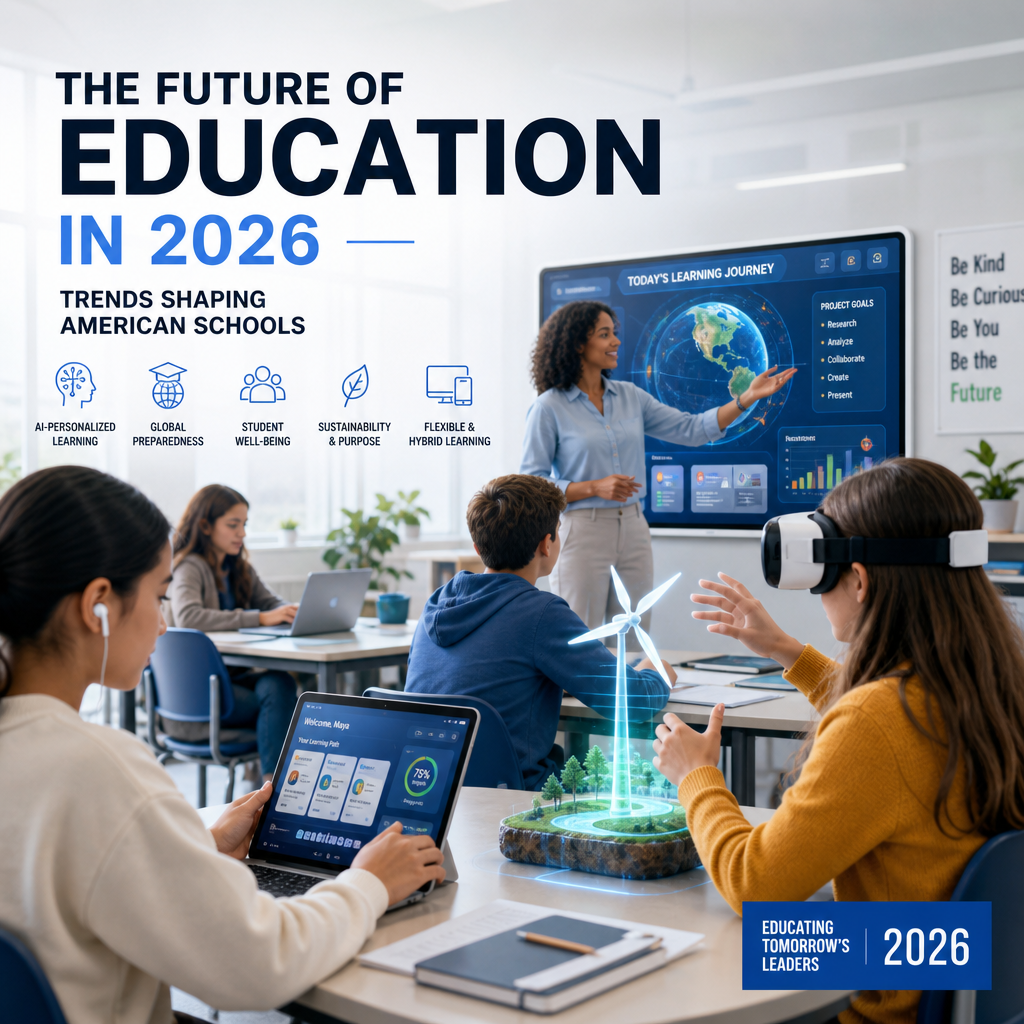
The Future of Education in 2026: Trends Shaping American Schools
The future of education is taking shape fast, and American schools in 2026 are rethinking how students learn, grow, and prepare for the real world. From personalized learning to AI and stronger student support, the biggest changes are aimed at making education more flexible, relevant, and effective.
By: Jennifer Collins on julho 30, 2026
American education is entering a period of rapid change, and the future of education in 2026 looks very different from the classroom model many people remember. Schools are balancing new technology, evolving student needs, teacher shortages, workforce demands, and a greater focus on well-being. At the same time, families expect learning to be more personalized, flexible, and relevant to real life.
The changes ahead are not just about gadgets or software. They reflect a broader shift in how schools define success, support students, and prepare young people for adulthood. From artificial intelligence in classrooms to career-connected learning and social-emotional support, the trends shaping American schools in 2026 will influence how students learn and how teachers teach.
The Future of Education in 2026: What American Schools Are Prioritizing
Schools across the country are focusing on practical improvements that respond to real challenges. Some of the biggest priorities include academic recovery, student mental health, teacher support, and technology integration. Rather than chasing every new trend, districts are looking for tools and strategies that make learning more effective and sustainable.
1. Personalized learning is becoming more common
One of the clearest trends in the future of education in 2026 is a stronger emphasis on personalized learning. Schools are increasingly using digital tools and data to tailor instruction to each student’s pace, strengths, and gaps.
This does not mean every student learns alone at a screen. In strong classrooms, personalized learning looks like:
Adaptive reading or math platforms that adjust difficulty in real time
Small-group instruction based on skill level
Choice-based projects that let students demonstrate understanding in different ways
Teacher-led interventions for students who need extra support
For example, a middle school student struggling with fractions might practice through a targeted learning app while the teacher works with a small group on related concepts. Meanwhile, advanced learners can move into enrichment work instead of waiting for the class to catch up.
Personalized learning helps students stay engaged, but it works best when teachers use it as one part of a well-rounded instructional approach.
2. Artificial intelligence will play a bigger role
AI is becoming one of the most talked-about topics in education, and its influence will continue to grow in 2026. In American schools, AI will likely support teachers more than replace them. The strongest use cases are practical and time-saving.
Teachers may use AI to:
Draft lesson ideas and discussion prompts
Create differentiated practice materials
Summarize student feedback patterns
Help with routine administrative tasks
Support tutoring or review activities
Students may also encounter AI tools for brainstorming, writing support, language translation, or practice questions. However, schools will need clear policies around academic integrity, privacy, and responsible use.
The most successful schools will teach students how to use AI thoughtfully. That includes understanding what AI can do, where it can be inaccurate, and why human judgment still matters. In the future of education in 2026, AI literacy may be just as important as digital literacy.
3. Career-connected learning is expanding
Parents, students, and employers increasingly want school to connect more clearly to real-world opportunities. That is why career-connected learning is gaining momentum in high schools and even earlier grades.
This trend includes:
Career and technical education (CTE)
Internships and apprenticeships
Dual enrollment with colleges
Job shadowing
Industry certifications
Project-based partnerships with local businesses
Schools are recognizing that not every student follows the same post-graduation path. Some head to four-year colleges, while others enter skilled trades, technical fields, military service, or direct-to-work opportunities. Career-connected learning helps students explore options and build practical skills before graduation.
A student interested in healthcare, for example, might take biology, complete a medical terminology elective, shadow a nurse, and earn a certification related to patient care. That kind of pathway makes learning feel more relevant and gives students a stronger sense of purpose.
Technology Will Be Smarter, But More Carefully Managed
Technology in schools is no longer a novelty. By 2026, the question is not whether schools use tech, but how they use it wisely. District leaders are paying more attention to digital safety, device management, screen time, and equitable access.
4. Schools will focus on digital responsibility and safety
As students spend more time online for learning and collaboration, schools must also teach digital responsibility. Cyberbullying, misinformation, weak passwords, and data privacy concerns are all part of the modern school environment.
Expect more schools to emphasize:
Online safety and cyber hygiene
Media literacy and source evaluation
Responsible use of school-issued devices
Privacy protections for student data
Clear rules for AI-generated work
These skills matter beyond the classroom. Students need to know how to spot unreliable information, protect personal accounts, and communicate respectfully online. Schools that treat digital citizenship as an essential skill will better prepare students for both college and careers.
5. Hybrid and flexible learning options will remain
The pandemic accelerated flexible learning models, and while most students are back in physical classrooms, some of those changes have stuck. In 2026, many schools will continue offering a blend of in-person and digital learning support.
This may include:
Recorded lessons for review
Virtual tutoring sessions
Online make-up work during absences
Hybrid options for some specialized programs
Learning management systems that centralize assignments and feedback
Flexibility is especially helpful for students with health needs, transportation challenges, or extracurricular demands. It can also support families who want better visibility into assignments and progress.
Still, schools must balance convenience with connection. The best digital tools should complement human relationships, not replace them.
Student Well-Being Will Stay at the Center
Academic achievement matters, but schools are also paying more attention to student well-being. In 2026, many American schools will continue investing in mental health, attendance support, and a stronger sense of belonging.
6. Mental health support will be embedded in school culture
More schools now understand that learning is harder when students are anxious, overwhelmed, or disconnected. As a result, mental health support is becoming part of everyday school life rather than something handled only after a crisis.
Common approaches include:
School counselors and social workers
Check-in systems and advisory periods
Mindfulness or stress-management lessons
Trauma-informed teaching practices
Referral pathways for outside support
Teachers are not mental health professionals, but they often notice when something is off. Schools that train staff to recognize warning signs and respond appropriately can better support students before problems escalate.
In 2026, the schools that succeed will likely be the ones that create calm, predictable, and supportive environments where students feel seen and respected.
7. Attendance and engagement will receive more attention
Chronic absenteeism has become a serious concern in many districts, and schools are responding with more proactive strategies. Families, educators, and community organizations are all part of the solution.
Effective attendance efforts may include:
Early outreach when absences begin to rise
Family communication in multiple languages
Transportation support where possible
Better school climate and student belonging initiatives
Mentoring programs for students who feel disconnected
Engagement matters too. Students are more likely to show up when they see value in the day. That means relevant instruction, strong relationships, and school activities that help them feel involved.
Teachers Will Need More Support, Not Just More Expectations
Any discussion of the future of education in 2026 has to include teachers. They are the people turning policy and technology into actual learning experiences. As schools evolve, teacher support will become even more important.
8. Professional development will become more practical
Traditional one-time workshops are no longer enough. Teachers need ongoing professional learning that is tied to their daily work.
Better professional development in 2026 will likely include:
Coaching and mentoring
Collaborative planning time
Training on AI and new edtech tools
Support for differentiated instruction
Strategies for literacy, math, and behavior support
Teachers are more likely to use new approaches when training feels useful and realistic. Schools that invest in hands-on, classroom-centered support will get better results than those that simply hand teachers another initiative.
9. Teacher retention will remain a major concern
Many districts continue to face staffing shortages, high workloads, and burnout. That makes retention a major issue in the years ahead. In 2026, schools will need to do more than recruit new teachers; they will need to make teaching a sustainable career.
That can include:
Reasonable workload expectations
Better planning time
Stronger administrative support
Mentorship for early-career teachers
Recognition of teacher expertise
When educators feel respected and supported, they are more likely to stay. That stability benefits students, families, and school communities as a whole.
Family Expectations Are Changing Too
Families now expect more transparency, more communication, and more involvement in the learning process. Schools in 2026 will likely continue improving how they connect with parents and caregivers.
10. Communication will become more direct and accessible
Many families want quick access to grades, assignments, attendance, and classroom updates. Schools are responding with parent portals, messaging apps, and more frequent progress updates.
Good communication in 2026 looks like:
Clear weekly updates from teachers
Multilingual communication options
Easy-to-use digital portals
Responsive outreach when concerns arise
Family-friendly explanations of academic standards
Strong communication helps families support learning at home. It also builds trust, especially when schools are transparent about expectations and challenges.
11. Parents will seek both rigor and relevance
Families are asking more questions about whether school is preparing students for the future. They want strong academic foundations, but they also want practical skills. That includes writing, problem-solving, communication, teamwork, and digital fluency.
Schools that can show how lessons connect to college, work, and life will stand out. In 2026, relevance may be one of the strongest drivers of family satisfaction.
What These Trends Mean for Students
Taken together, these shifts point to a more flexible, student-centered education system. But the future of education in 2026 is not about replacing traditional learning with technology or short-term trends. It is about building schools that are more responsive, inclusive, and effective.
Students are likely to benefit from:
More personalized instruction
Better access to career pathways
Stronger mental health support
More meaningful use of technology
Clearer communication with teachers and families
At the same time, schools will need to guard against common pitfalls. Too much screen time, poorly implemented AI, weak privacy protections, and uneven access to technology can create new problems. The best schools will move carefully, test what works, and keep student needs at the center.
Practical Steps Schools Can Take Now
Schools that want to prepare for 2026 do not need to overhaul everything overnight. Small, strategic changes can make a real difference.
A useful starting list
Review current technology tools and remove what is not working.
Train teachers on practical AI use and digital citizenship.
Expand counseling, mentoring, and attendance supports.
Build stronger career exploration options in middle and high school.
Improve family communication through simple, consistent channels.
Protect teacher planning time and reduce unnecessary burdens.
Use student feedback to guide school improvement efforts.
These steps are manageable, but they can create momentum. Schools that listen to students, support teachers, and plan with purpose will be better positioned for the future.
Frequently Asked Questions
What is the biggest trend in the future of education in 2026?
One of the biggest trends is the move toward more personalized, flexible learning. Schools are using technology, student data, and targeted instruction to help students learn at the right pace and in ways that better match their needs. Career-connected learning and AI integration are also major forces shaping the future.
Will AI replace teachers in American schools?
No. AI is more likely to support teachers than replace them. It can help with lesson planning, feedback, and routine tasks, but teachers still provide the relationships, judgment, and classroom leadership that technology cannot replicate. Schools that use AI well will keep teachers at the center.
How will schools support student mental health in 2026?
Many schools will expand counseling, advisory programs, trauma-informed practices, and attendance support. Some will also build daily check-ins, peer mentoring, and wellness lessons into the school culture. The goal is to create environments where students feel safe, connected, and ready to learn.
What role will career and technical education play?
Career and technical education will play a much larger role in helping students explore real-world pathways. Many schools are expanding internships, apprenticeships, dual enrollment, and industry certifications. These programs help students connect academics to careers and make informed decisions after graduation.
How can families prepare for changes in education?
Families can stay informed by checking school communications, asking about learning goals, and exploring the tools their children use at school. It also helps to talk with students about time management, digital responsibility, and future goals. The more families understand the direction of education, the better they can support students.
The future of education in 2026 is being shaped by a simple reality: schools must prepare students for a world that is more digital, more interconnected, and more demanding than ever. That means using technology wisely, supporting student well-being, expanding career-connected learning, and giving teachers the tools they need to succeed. It also means keeping the human side of education front and center.
The most effective American schools will not be the ones that adopt every new trend. They will be the ones that choose what truly helps students learn, grow, and thrive. Personalized instruction, responsible AI use, stronger family communication, and meaningful career pathways all have a role to play. So do mental health support and teacher retention efforts.
For educators, families, and community leaders, the next step is clear: stay informed, stay flexible, and focus on what works for students. The future of education in 2026 is not something that happens to schools. It is something schools build, one decision at a time.
Jennifer, M.Ed., holds a degree in Higher Education Administration, with
a focus on U.S. college financial aid, admissions policy, and student
support systems. She researches and writes about scholarships, federal
aid programs, and the college planning process to help students and
families make informed, well-supported decisions.