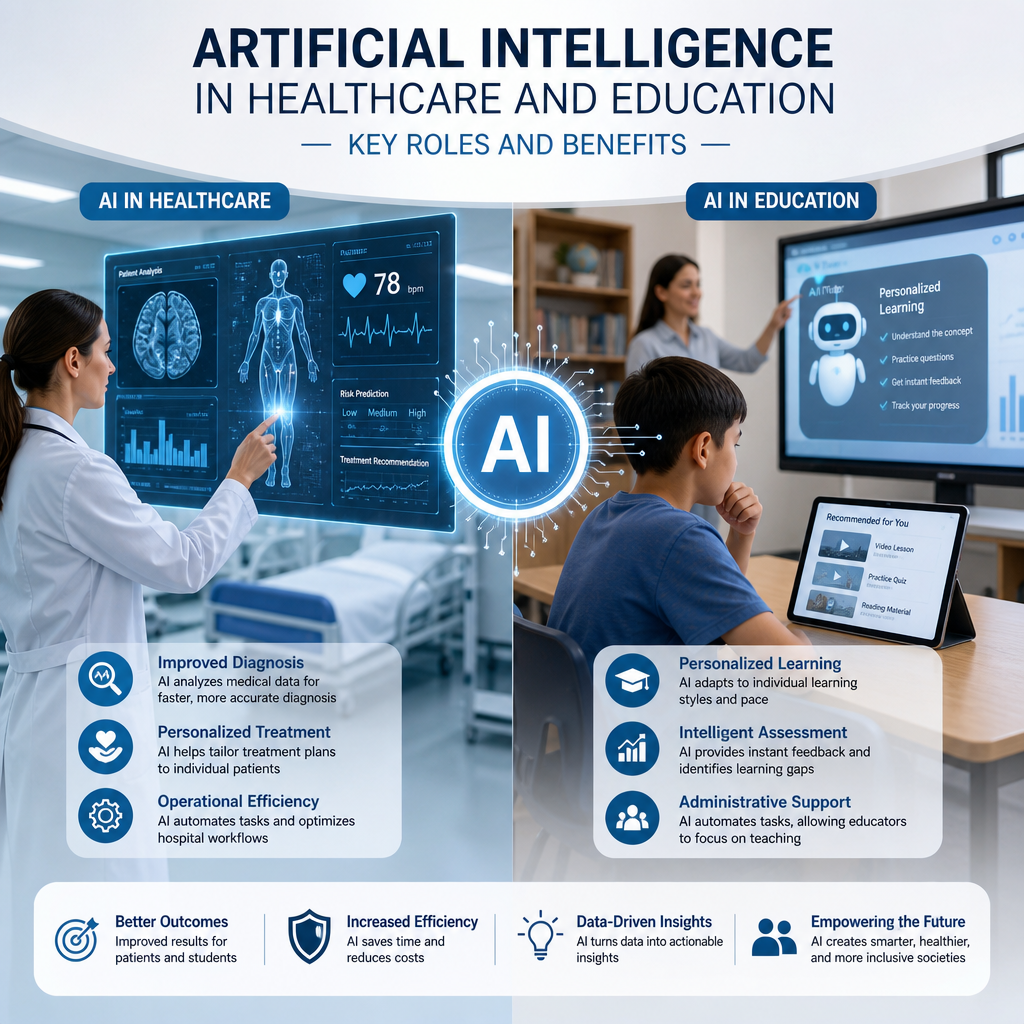
Artificial Intelligence in Healthcare and Education: Key Roles and Benefits
Artificial intelligence healthcare is helping clinicians work faster, make better-informed decisions, and deliver more personalized care. From streamlining routine tasks to supporting complex diagnoses, AI is becoming a practical tool that can improve outcomes while keeping human expertise at the center.
By: Peter B on julho 30, 2026
Artificial intelligence is changing the way people learn, work, and receive care. In both healthcare and education, AI is moving beyond buzzword status and becoming a practical tool for improving speed, accuracy, personalization, and access. The role of artificial intelligence in healthcare and education is especially important because these two fields depend on timely decisions, human judgment, and trust. When used responsibly, AI can help professionals do their jobs better while making services more responsive to individual needs.
Still, AI is not a magic solution. It works best when paired with human expertise, ethical oversight, and clear goals. In healthcare, that means better support for clinicians and patients. In education, it means more adaptive learning and more efficient teaching tools. Understanding where AI helps most—and where caution is needed—can make all the difference.
Understanding the Role of Artificial Intelligence in Healthcare and Education
Artificial intelligence refers to computer systems that can perform tasks normally associated with human intelligence, such as recognizing patterns, making predictions, understanding language, and generating content. In healthcare and education, AI often serves as an assistant rather than a replacement.
The role of artificial intelligence in healthcare and education includes:
Analyzing large amounts of data quickly
Supporting better decision-making
Personalizing services for individuals
Automating repetitive administrative tasks
Improving access to expertise and resources
These benefits matter because both industries face significant pressure. Healthcare systems must manage rising demand, complex records, and staffing challenges. Education systems must support diverse learners, reduce administrative burden, and adapt to changing expectations. AI can help address these challenges when used thoughtfully.
How AI Is Transforming Healthcare
AI has several practical uses in healthcare, and many of them focus on improving efficiency and supporting clinical work. The most successful applications tend to be those that enhance—not replace—medical professionals.
Supporting diagnosis and clinical decision-making
One of the most visible uses of AI in healthcare is helping providers identify patterns in medical data. AI tools can assist with:
Reviewing medical images such as X-rays or MRIs
Flagging possible abnormalities for further review
Identifying risks based on patient records
Helping clinicians prioritize urgent cases
These tools can be valuable in busy settings, especially when used as decision support systems. A radiologist, for example, may use AI to highlight a suspicious area in an image, then make the final judgment based on training and context.
Improving patient monitoring and care management
AI also helps monitor patients more continuously and proactively. This can include wearable devices, remote patient monitoring platforms, and systems that detect changes in vital signs or behavior patterns.
Practical examples include:
A wearable device that alerts a care team if a patient’s heart rate changes unexpectedly
Software that helps manage chronic conditions by tracking medication adherence
Predictive tools that identify patients who may need follow-up care
This kind of support can be especially useful for people with long-term conditions, older adults, or patients recovering at home.
Streamlining administrative tasks
Healthcare professionals spend a large amount of time on paperwork and coordination. AI can reduce that burden by helping with:
Appointment scheduling
Medical transcription
Claims processing
Insurance verification
Drafting patient communications
By automating routine tasks, AI may give clinicians and staff more time to focus on patient care. That matters because administrative overload can contribute to stress and reduce efficiency.
Accelerating drug discovery and research
AI is also helping researchers process vast amounts of scientific data. In drug discovery, for example, AI can identify promising compounds, predict how molecules may behave, and support faster analysis of research results.
This does not eliminate the need for clinical trials or expert review. But it can help researchers move more efficiently through early stages of discovery, which may shorten timelines and reduce wasted effort.
How AI Is Changing Education
The role of artificial intelligence in healthcare and education becomes especially clear in classrooms and learning platforms. In education, AI is often used to personalize learning, support teachers, and make resources more accessible.
Personalizing the learning experience
Students do not learn at the same pace or in the same way. AI can help create more personalized learning experiences by adapting content based on performance, preferences, and progress.
For example:
A math platform may provide easier review problems after repeated mistakes
A reading app may suggest texts based on skill level and interests
A tutoring system may offer extra explanations when a student struggles
This kind of personalization can help students stay engaged and better understand material without requiring one-size-fits-all instruction.
Helping teachers save time
Teachers often manage lesson planning, grading, feedback, communication, and classroom administration. AI can reduce the time spent on repetitive work by assisting with:
Drafting lesson outlines
Generating quiz questions
Sorting student performance data
Providing early feedback on writing
Organizing classroom materials
When used well, AI gives teachers more time to focus on direct instruction, student support, and professional judgment.
Expanding access to learning
AI tools can make education more accessible for students with different needs. Examples include:
Speech-to-text tools for students who have difficulty writing
Text-to-speech tools for students with reading challenges
Translation tools for multilingual learners
Adaptive platforms for students with varying levels of support
These tools can remove barriers and help more learners participate fully in the classroom.
Supporting data-informed instruction
AI can help educators understand patterns in student performance more quickly. Instead of guessing which lessons need reinforcement, teachers can use AI-supported dashboards and analytics to see where students are struggling.
That insight may help with:
Identifying gaps in understanding
Grouping students for support
Adjusting lesson pacing
Tracking progress over time
The goal is not to let data replace teaching intuition. Rather, it is to give educators better information so they can respond more effectively.
Benefits of AI Across Both Fields
Although healthcare and education are different, the benefits of AI often overlap. In both settings, AI can improve outcomes by making systems smarter, faster, and more responsive.
Common advantages include:
Efficiency: Reducing repetitive work and speeding up routine tasks
Personalization: Tailoring support to individual needs
Accessibility: Expanding access to services and tools
Consistency: Helping systems apply standards more reliably
Insight: Revealing patterns that might be difficult to notice manually
These benefits are strongest when AI is implemented with clear purpose and strong human oversight. Poorly designed systems can create confusion or even introduce new problems.
Challenges and Risks to Consider
The role of artificial intelligence in healthcare and education is promising, but it also raises serious concerns. Responsible use requires awareness of the risks.
Data privacy and security
Healthcare and education involve sensitive personal information. AI systems often depend on large datasets, which means organizations must take privacy seriously.
Key concerns include:
Unauthorized access to personal data
Data sharing without proper consent
Weak security practices
Misuse of sensitive records
Organizations should use secure systems, limit access, and follow relevant privacy laws and policies.
Bias and fairness
AI systems learn from data, and data can reflect existing bias. If a system is trained on incomplete or unbalanced information, it may produce unfair or inaccurate results.
This can affect:
Medical recommendations
Student assessments
Predictive analytics
Access to resources
Fairness testing and human review are essential. AI should support equity, not deepen existing disparities.
Overreliance on automation
AI can make mistakes, especially when faced with unfamiliar situations or incomplete information. In both healthcare and education, professionals should treat AI as a tool—not a final authority.
A few examples of healthy caution:
A doctor reviews AI-generated findings before acting on them
A teacher checks automated feedback for tone and accuracy
An administrator validates data-driven recommendations before implementation
Human expertise remains critical.
Digital divide and unequal access
Not every school or healthcare provider has the same technology, funding, or infrastructure. If AI tools are only available to well-resourced organizations, they may widen existing gaps.
Access issues can include:
Limited internet connectivity
Inadequate devices
Insufficient staff training
Budget constraints
To be truly helpful, AI solutions must be practical and scalable across different settings.
Best Practices for Responsible AI Use
To maximize value and reduce harm, schools, hospitals, and health systems should follow thoughtful implementation practices.
1. Start with a clear use case
AI should solve a specific problem, not be added just because it is available. Organizations should ask:
What task needs improvement?
Who will use the tool?
How will success be measured?
What happens if the system is wrong?
2. Keep humans in the loop
Human review is essential in both healthcare and education. Professionals should have the final say in decisions that affect diagnosis, treatment, grades, placement, or access to support.
3. Train staff and users
Even strong tools fail when people do not understand how to use them. Training should cover:
How the tool works
What it can and cannot do
How to interpret outputs
How to report problems
4. Monitor outcomes regularly
AI systems should be evaluated over time for accuracy, fairness, and usefulness. This includes checking for unintended consequences and adjusting workflows when necessary.
5. Protect privacy and follow policy
Organizations should establish clear rules for data handling, consent, retention, and vendor oversight. Responsible AI requires strong governance.
Real-World Examples of AI in Action
The role of artificial intelligence in healthcare and education becomes clearer through everyday use cases.
Healthcare example
A hospital may use AI to help prioritize emergency room imaging results. The system flags likely urgent cases so clinicians can review them sooner. The doctor still makes the final decision, but the AI helps reduce delays.
Education example
A school district may use AI-powered reading software to support elementary students. The platform adjusts reading difficulty based on performance, provides vocabulary help, and gives teachers reports on progress. This allows instruction to become more targeted without increasing workload dramatically.
These examples show how AI works best when it supports professionals rather than replacing them.
The Future of AI in Healthcare and Education
AI will likely become more integrated into daily workflows in both fields. Future improvements may include better natural language tools, stronger predictive analytics, more accessible tutoring systems, and improved decision support.
But the future should not be measured only by capability. It should also be measured by trust, fairness, and real-world usefulness. A tool is only valuable if it improves outcomes without creating new harms.
That is why leaders in healthcare and education need to think carefully about policy, training, transparency, and evaluation. The goal should be responsible innovation that serves people first.
Frequently Asked Questions
1. What is the role of artificial intelligence in healthcare and education?
The role of artificial intelligence in healthcare and education is to support professionals and users by improving efficiency, personalization, and decision-making. In healthcare, AI can assist with diagnosis, monitoring, and administrative tasks. In education, it can personalize learning, help teachers save time, and improve accessibility.
2. Can AI replace doctors or teachers?
No. AI can support doctors and teachers, but it cannot replace human judgment, empathy, and experience. In healthcare, professionals must interpret clinical information in context. In education, teachers understand student behavior, motivation, and social needs in ways AI cannot fully replicate.
3. How does AI personalize learning for students?
AI can adjust lessons, practice questions, feedback, and pacing based on a student’s performance. If a student struggles with a topic, the system may provide extra support. If a student progresses quickly, it may offer more advanced material. This helps create a more individualized learning experience.
4. What are the biggest risks of using AI in healthcare and education?
The biggest risks include privacy concerns, bias, overreliance on automation, and unequal access to technology. AI systems may also produce errors or misunderstand context. That is why human oversight, careful testing, and strong data protection are essential.
5. How can schools and hospitals use AI responsibly?
They can use AI responsibly by starting with clear goals, keeping humans involved in decision-making, training staff, monitoring outcomes, and protecting sensitive data. Responsible use also means checking for bias and making sure the technology truly improves services.
The role of artificial intelligence in healthcare and education is growing because both fields need smarter ways to manage information, support people, and improve outcomes. In healthcare, AI can help with diagnosis, monitoring, administration, and research. In education, it can personalize learning, reduce teacher workload, and improve accessibility for diverse learners. Across both areas, the most effective use of AI is not about replacing professionals. It is about giving them better tools to do their work with more precision, efficiency, and insight.
At the same time, successful AI adoption depends on responsibility. Privacy, fairness, human oversight, and training all matter. Organizations that rush implementation without clear safeguards risk creating more problems than they solve. The best approach is thoughtful, measured, and centered on human needs.
As AI continues to evolve, schools, hospitals, and policymakers should focus on practical benefits, ethical use, and long-term trust. By doing so, they can use technology not just to automate tasks, but to improve lives in meaningful, lasting ways.
Peter B holds a degree in Journalism and has 5 years of experience covering U.S. economic policy, labor markets, and financial news. He writes data-driven news content on topics like inflation, interest rates, and employment trends.